GeoDirectory

GeoDirectory vs Directorist – which plugin will you trust?

What’s best, Directorist or GeoDirectory?

We’ll get this out of the way first: we make GeoDirectory.

So this isn’t a neutral review, and we won’t pretend it is.

What it is: an honest, detailed comparison from people who’ve spent years building directory sites and watching what breaks at scale.

We know both plugins. We know where Directorist is genuinely good, where it falls short, and where GeoDirectory pulls ahead.

If you’re reading this, you’ve already done the hard work.

You picked WordPress. You picked the directory niche. You’ve narrowed it down to the two plugins most people choose between.

Now you want a straight answer.

Most comparison posts give you another feature table and leave you exactly where you started.

The two plugins look similar on the surface. Both have free versions, paid add-ons, search, maps, reviews, and frontend submissions.

The real differences show up later, usually when you have a few hundred listings, a few paying customers, and a real need for performance, SEO, and flexibility at scale.

That’s where this comparison lives.


Why we’re writing this

For years, we resisted writing competitor comparisons. They tend to be biased, age badly, and pull energy away from building the product.

We held that position even as other vendors in the space published comparisons of us that were, to put it mildly, generous with the facts.

The current state of affairs changed our minds.

Directorist has published multiple comparison articles about GeoDirectory on their own blog.

The most recent (updated November 2025) makes a number of claims that don’t survive a basic check.

To pick a handful that anyone can verify, it lists GeoDirectory as:

Every one of those claims is false, and each is directly contradicted by our own public product pages, the WordPress.org plugin repository, and (in the case of Elementor) the documentation linked from the Directorist authors’ own blog.

That’s marketing. We can live with marketing.

What pushed this article into existence is search. Google is now showing Directorist’s comparison content directly alongside searches for our brand and our features.

Users researching GeoDirectory are landing on a page that misrepresents what GeoDirectory does, written by a vendor with a strong commercial interest in misrepresenting it.

We decided that if we were going to be compared to publicly, we’d rather be compared to honestly.

So we wrote this article. We wrote it with the highest standard of honesty we could hold ourselves to, including being honest about ourselves where it would have been easier not to.

You’ll find a section in the middle of this article about Security that documents serious public incidents in Directorist’s history. You’ll find another section about Reputation that documents specific behaviors their own support team has been publicly accused of.

Both sections cite primary sources. Both are uncomfortable to write. Neither is invented.

If you came here looking for a comparison that pulls punches, this isn’t it. If you came here looking for a comparison that makes things up, this isn’t that either.

We’re showing the receipts. Read them carefully, follow the links, and decide for yourself.


TL;DR

This article is a detailed comparison of two mature WordPress directory plugins, just over 16,000 words. It takes about an hour to read in full. If you’re short on time, here’s the short version.

We make GeoDirectory. So this isn’t a neutral comparison, and we won’t pretend it is.

What it is: an honest, source-cited breakdown of where each plugin wins, where each falls short, and what the public record says about how each vendor behaves.

The 30-second verdict: Directorist gets you to a working directory faster, cheaper, and with a more polished out-of-the-box experience.

GeoDirectory gets you a directory built to grow, rank, monetize, and run for years without hitting the architectural walls the rest of this article documents.

For a hobby project under 500 listings with no monetization plans, Directorist is a defensible choice. For anything you plan to run as a business, the public record makes GeoDirectory’s case for us.

The differences that matter most:

GeoDirectoryDirectorist
Listing data storageCustom database tables with proper indexingWordPress post meta
Performance at scale2 million listings in production on a $600/month serverSlows under combined custom-field filters on standard hosting
Location URLsNative location-category hierarchy (/restaurants/california/san-francisco/)Flat taxonomy. No native “X in Y” URLs
Map at scaleServer-side marker clustering up to 1M markersClient-side clustering, struggles past 2,000 markers
EventsDedicated Events module with dates, status, calendar, and archiving“Make a directory and label categories as Events.”
Multi-location businessesFranchise Manager with parent-child listings and locked fieldsMulti-tagged taxonomies, no real franchise model
CSV importerImports new listings and updates existing ones in bulkImports only, no bulk updates
AI featureNone marketedMarketed as AI-powered. The released feature proxies prompts to their server with no consent UI. Advanced features marked “Coming Soon” on their own page
Public CVE record~15 disclosed CVEs since 2018, never closed by WordPress.orgMultiple critical CVEs, including CVSS 9.8 in 2025-2026, plugin forcibly closed by WordPress.org in 2023
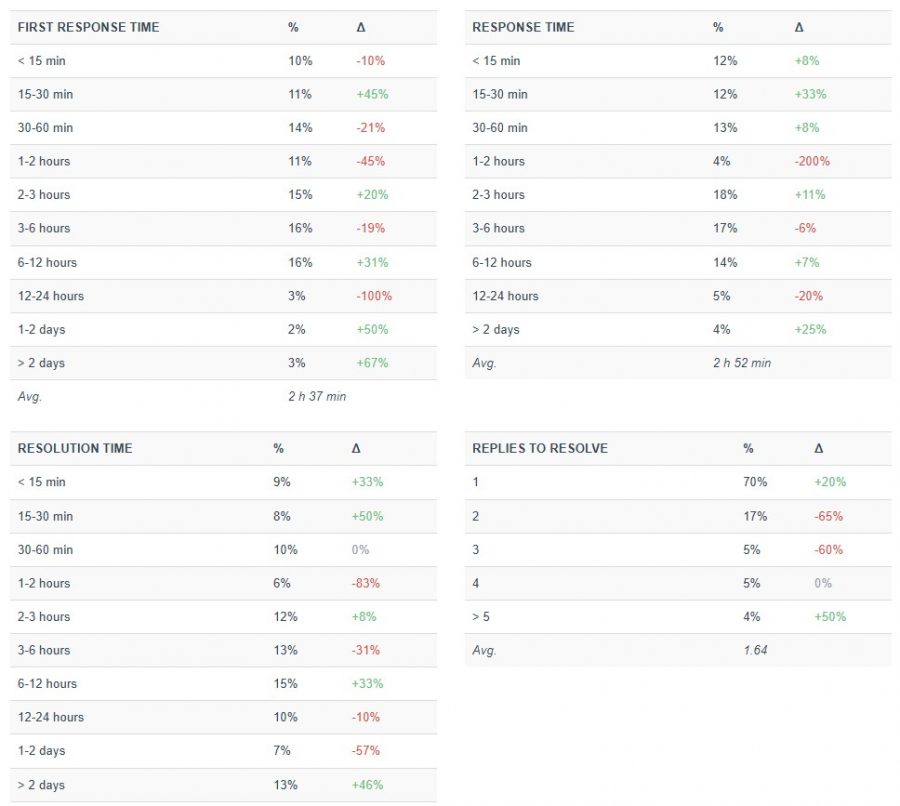
Support response time2h 31min average, 65% resolved in one replyNot publicly disclosed
Reputation patternPast mishandling of bad reviews from 2018-2022, no 1-star reviews in 4 yearsMultiple recent users report conditional support (positive review required) on the public WordPress.org forum
3-year cost (unlimited sites)$687 total, no perpetual discount$404 total, perpetual discount that may violate UK consumer law

If the table makes the case for you, GeoDirectory Membership is $229 a year. If you want the evidence behind every row, the rest of the article walks through it section by section.


And now the full version.

Here’s what we’ll cover:

  1. Features Comparison (free plugins)
  2. Design & Customization
  3. Listing Details
  4. Frontend Submission & User Dashboards
  5. Claim Listings
  6. The Search Engine
  7. Maps, Features & Locations
  8. Ratings & Reviews
  9. Monetization & Marketing Tools
  10. Mobile Features
  11. SEO & Schema
  12. Performance & Scalability
  13. Security
  14. Multilingual
  15. User Friendliness
  16. Developer Extensibility & Integrations
  17. Import / Export & Migration
  18. Support, Documentation & Reputation
  19. Pricing and TCO
  20. Verdict

Let’s dive into each one and see how GeoDirectory and Directorist stack up.


Features Comparison (free plugins)

Both plugins are free on WordPress.org and include a working directory. The differences show up in defaults and depth.

Listings and structure

GeoDirectory ships with one default custom post type (Places) tied to a single city. The location page acts as the directory home, where you can add content if your site’s home is more generic.

Listings outside the default city can still be added, but they won’t have their own location page until you add the Location Manager add-on.

Directorist’s free version lets you create multiple directory types out of the box, each with its own fields and layout. That’s a real advantage if you want to manage Places, Jobs, and Services from a single install without paying for an add-on.

Events

Directorist’s documentation suggests building an event directory by creating a regular directory and labeling categories as “Events.” There are no event-specific fields, no start and end dates, no status tracking, and no calendar in the free plugin.

GeoDirectory has a dedicated free Events for GeoDirectory add-on on WordPress.org that adds proper event date fields, status tracking (Upcoming, Ongoing, Past), the ability to archive past events, calendar widgets, and integration with the default search so users can filter by date.

If events are part of your plan, the gap here is significant.

Locations

Directorist treats locations as a taxonomy, so users can browse by category or by location, but not by both.

GeoDirectory treats locations as a structured hierarchy with their own pages, which makes URLs like /restaurants/paris/ possible out of the box.

We’ll come back to this in the SEO section because the implications run deeper than feature parity.

Search

GeoDirectory’s default search has two fields: a “Search for” field that searches Title, Description, Categories, and Tags, and a “Near” field for a street address or zip code. The two combine and return results by proximity.

Directorist has three default fields and adds a sidebar with extra filters like star ratings, tags, and price ranges ($ to $$$$).

Based on our testing, Directorist’s keyword search doesn’t reach into categories and tags by default, so the depth of each field varies, even if the count favors them.

Directorist also runs search via AJAX. GeoDirectory does too, but only with the Advanced Search add-on.

Maps

Both support Google Maps and OpenStreetMap.

GeoDirectory’s free version ships the synced side-by-side layout: an interactive map on one side, listings on the other, paginated together so the map updates as the user changes page.

Directorist’s free version offers map as a standalone layout (toggle between list, grid, and map), with all listings shown as pins. To get the synced side-by-side layout that Yelp and Airbnb use, you need their paid Listings With Map extension for $39 per year.

GeoDirectory’s mapping also uses server-side caching, which matters once you push past a few thousand listings.

Reviews

GeoDirectory uses the WordPress comments system, extended with a 1-to-5-star rating, tied to the Places CPT.

Ratings can drive the default sort order on the archive. Directorist has its own review system with approval from admins and authors.

Custom fields, import and export, REST API

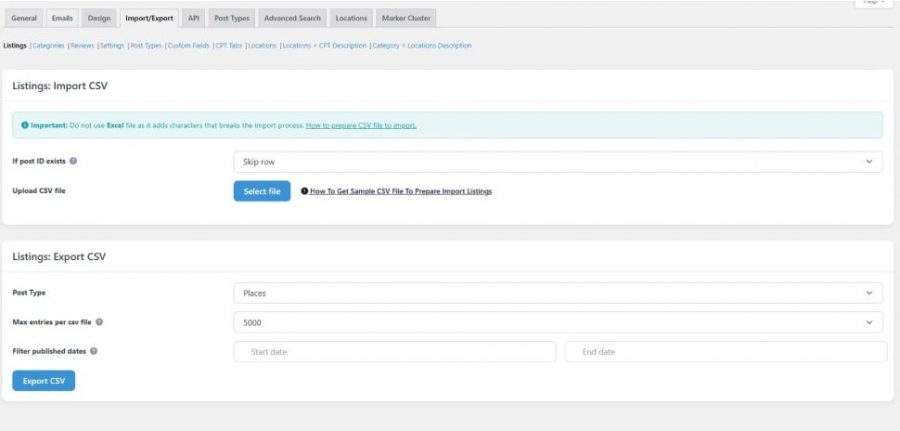
Both plugins ship a custom fields builder with conditional logic, CSV import and export, and a REST API in their free version.

The one practical difference: GeoDirectory’s CSV importer also handles bulk edits, so you can re-import a modified CSV to update existing listings. Directorist’s importer is currently add-only.

The deeper comparison sits in the Listing Details section below.

Contact forms on listings

GeoDirectory ships a built-in form when paired with the Blockstrap theme. With any other theme, you’ll need Ninja Forms.

Directorist includes contact options in the listing template by default.

The honest takeaway

Directorist gives you more out-of-the-box in places that look impressive on a feature sheet: multiple directory types, AJAX search, and sidebar filters.

GeoDirectory gives you fewer features on the surface, but each one is built more deeply. Events are a proper module rather than a relabel. Locations are a real hierarchy rather than a taxonomy.

The synced map and listings layout, the pattern most directory builders actually want, ships free with GeoDirectory and costs $39 a year as a Directorist add-on. The map layer is engineered to scale. The CSV importer handles updates, not just additions.

That pattern, more features in their marketing versus more depth in our engineering, runs through most of the rest of this comparison.


Design & Customization

The two plugins take genuinely different approaches here, and the right one depends on whether you want speed or ceiling.

Directorist uses a visual Directory Builder

Inside the admin, you get tabbed sections for the General settings, Add Listing Form, Single Page Layout, All Listings Layout, and Search Form.

Each one opens into a drag-and-drop canvas where you toggle widgets on or off, reorder them, and configure each from a sidebar.

The Single Page Layout further splits into Listing Header, Listing Contents, and a Custom Single Listing Page tab for more advanced edits.

It’s intuitive, and you can ship a polished-looking directory in an afternoon.

The trade-off is that you’re working inside a defined system. Layouts have prescribed slots. Components are the ones Directorist gives you.

When you need something the builder doesn’t offer, you’re either writing custom PHP to extend it or working around the constraint.

GeoDirectory uses page templates

Out of the box, GeoDirectory ships templates for every major surface of the directory: GD Details (the single listing page), GD Archive (the listings index), GD Search Page (the search results), GD Archive Item (the listing card used inside archives and search), GD Add Listing Page (the submission form), and GD Location Page (which, paired with the Location Manager add-on, generates custom location pages at scale).

Each template can be customized in three ways.

Developers can replace the PHP template entirely and write it however they want.

Site builders without code can edit templates using shortcodes and CSS, or use a visual builder like Gutenberg, Elementor Pro, or Bricks, which includes dynamic content widgets.

If the active theme is a Full Site Editing theme, the templates open in the WordPress block editor as well.

Every individual piece of listing metadata is available as a block or element, so you can place it exactly where you want and style it exactly how you want.

Pre-built blocks ship with opinionated designs if you’d rather start from a working baseline than from scratch.

The honest trade-off is a steeper learning curve. New users sometimes find the choice of editors overwhelming and aren’t sure where to start.

We’re addressing that in GeoDirectory v3 with a more guided setup experience.

Speed or ceiling

Directorist will get you to a working directory faster, especially if you’ve never built one before.

GeoDirectory gives you a higher ceiling: any layout, any builder, any level of code intervention, and no walls when your requirements grow.

For a hobby site or an MVP, faster wins. For a directory you plan to scale, customize for clients, or hand off to a developer down the line, the ceiling matters more.


Listing Details (CPTs + Events, Custom Fields, Franchise Manager, Compare Listings)

This is where directory plugins start to show their true shape. The headline features are similar. The architecture underneath them is where the differences live.

CPTs and Events

Both plugins support multiple listing types.

Directorist does it through its multi-directory system, which is free and lets you create unlimited directory types from a single install.

GeoDirectory does so through its paid Custom Post Types add-on. That’s a clear point for Directorist in terms of price and out-of-the-box convenience.

The trade-off shows up specifically with events. Directorist’s recommended approach is to create another directory type and label categories as Events, with no event date fields, no status tracking, and no calendar in the free plugin.

GeoDirectory’s free Events add-on adds proper event date fields, status (Upcoming, Ongoing, Past), past-event archiving, calendar widgets, and integration with the default search.

Custom fields

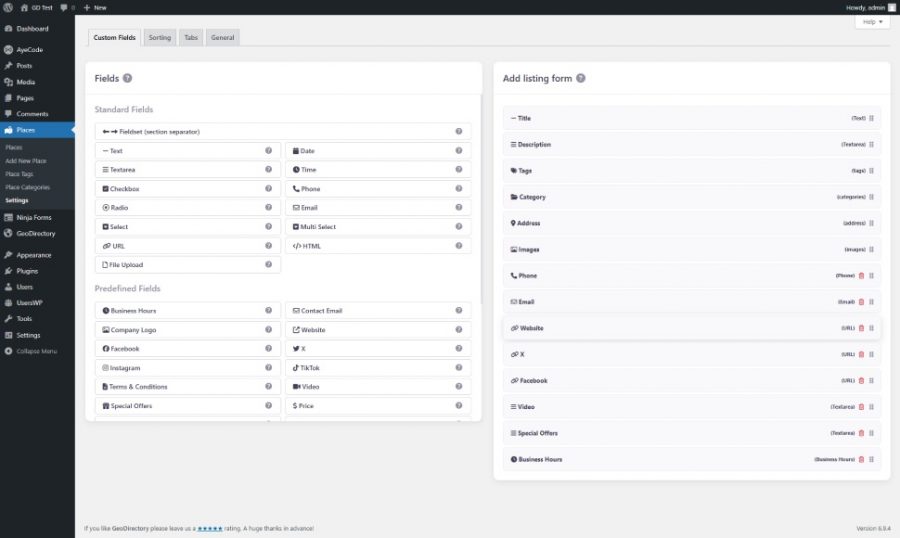
GeoDirectory Custom Fields

Both plugins ship a drag-and-drop custom fields builder with conditional logic in the free version.

The standard field types are largely the same: text, textarea, checkbox, radio, select, multi-select, URL, file upload, date, time, phone, and email.

Both also offer predefined fields like business hours, social profiles (Facebook, Instagram, X, TikTok), video, and pricing.

The architectural difference matters more than the field menu. GeoDirectory stores listing data in custom database tables rather than WordPress post meta, which keeps queries fast as the directory grows past a few thousand listings.

Directorist uses standard post meta. We’ll come back to the scaling implications in the Performance section.

Franchise Manager

This is one of the most common requests we hear: how do I add multiple addresses to the same business?

GeoDirectory’s Franchise Manager add-on solves this with a parent-and-child listing model. You create a parent listing for the chain or franchise, then add child listings for each location.

Fields like title, description, logo, and any custom field you choose can be locked at the parent level. Edit them on the parent, and they update across every child listing.

Address, phone, business hours, and anything else that varies per location stay open for each child to set independently.

The add-on integrates with the CSV importer, allowing you to bulk-create child listings without manual entry.

Directorist’s documentation and marketing mention multi-location support, but in practice, they only assign multiple location taxonomy terms to a single listing.

It’s a way to make a single listing appear under several location archives, not a way to manage separate addresses, phone numbers, or hours for each location in a real chain.

For a one-person business serving a few neighborhoods, that’s enough. For an actual franchise or multi-location business, it isn’t.

GeoDirectory’s approach was built around the specific problem of running a chain at scale without sacrificing data integrity, which is why the lock-and-unlock model exists.

Compare Listings

Both plugins offer a Compare Listings add-on at similar price points and with similar functionality: users select listings, see them side by side in a table or lightbox, and the comparison includes custom fields.

GeoDirectory’s version uses browser storage, so there’s no GDPR cookie overhead, supports comparison across multiple pages, generates shareable URLs for each comparison, and lets you embed a comparison of specific listing IDs via shortcode or block.

Directorist’s version places the compare button anywhere in the layout via the Directory Builder. Feature parity in the basics, with small advantages on either side depending on the use case.

What this means for your build

Directorist wins on multi-directory pricing (free vs paid in GD).

GeoDirectory wins on every depth question: events as a proper module, custom data stored for scale, and an actual franchise model rather than a taxonomy workaround.

The pattern from the last section holds: more in their feature sheet, more in our engineering.


Frontend Submission & User Dashboards

This section is about the listing owner’s experience, not the visitor’s. The submission form, the dashboard where they manage their listings, and everything in between.

Frontend submission form

Both plugins ship a frontend submission form in the free version. Visitors can register, submit a listing, upload images, set a map location, and fill out custom fields without ever seeing the WordPress admin.

Directorist ships a multi-step form natively, which is a nice touch for longer submission flows.

GeoDirectory doesn’t have multi-step out of the box: a third-party plugin handles it today, and native multi-step is coming in GeoDirectory v3.

Image upload, map picker, and custom field support are available in both free versions.

Pricing on submission

Both plugins support tiered submission pricing through a paid add-on.

GeoDirectory’s Pricing Manager and Directorist’s Pricing Plans both let you restrict features per plan: free listings with limited fields, paid listings with more categories, longer descriptions, additional images, featured placement, and so on.

Feature parity here.

Guest submissions

Both support guest submissions in the free version.

GeoDirectory requires an email address at submission time and automatically creates the user account, sending the password to the provided email address.

Directorist offers a similar guest flow that can be toggled on or off.

User dashboard

This is where the two diverge.

Directorist ships a frontend user dashboard in the free version with tabs for listings, bookmarks, reviews, orders, and account settings. It’s tied directly to the plugin and works out of the box.

GeoDirectory uses the free UsersWP plugin (made by the same team) for its dashboard.

The basic version is shared between visitors and listing owners and shows the user’s listings with edit and delete links, favorites, reviews, blog posts, and comments. It’s functional but generic.

The premium UsersWP Dashboard add-on is where the depth shows up. It’s role-based, so admins get a site management dashboard with stats, user management, listing moderation, and payment review; listing owners get a dedicated business management view with listings, messages, bookings, and inquiries; regular users get a clean account view.

It integrates with the full UsersWP, GeoDirectory, and WP GetPaid (our payments plugin) ecosystem out of the box.

If you’re running a serious directory with payments, bookings, and messaging, this dashboard is built for that. Directorist’s free dashboard is solid for the core directory case, but doesn’t reach the same depth of integrations.

Which one fits

Directorist offers a more complete out-of-the-box experience in its free version, including a dashboard and a multi-step submission process.

GeoDirectory ships the essentials free and then offers a significantly more capable, role-based dashboard as a paid add-on.

If you want to launch fast and free, Directorist is the cleaner path. If you’re planning to run a full operation with payments, bookings, and multi-role users, the GeoDirectory dashboard is in a different league.


Claim Listings

Claim Listings is a feature both plugins offer as a paid add-on, with similar core functionality and meaningful differences in price and depth.

The core flow is the same on both sides

A site owner pre-populates listings; the real business owner finds their listing and submits a claim; the admin reviews and approves; and the business owner takes over management.

Both plugins handle this baseline well.

Both support free or paid claims

GeoDirectory’s Claim Listings works with the Pricing Manager add-on to charge for claims, with GetPaid or WooCommerce as payment systems.

Directorist’s Claim Listing works with their Pricing Plans or WooCommerce Pricing Plans for the same purpose.

Both let you offer a free claim, a fixed claim fee, or a tiered upgrade where claiming unlocks more listing features (more categories, longer descriptions, additional images).

Price

Directorist’s add-on is $29 per year for a single site, GeoDirectory’s is $49. That’s a real point on price.

Depth

GeoDirectory’s add-on goes further in the workflow. Claims can be auto-approved via email verification or upon receipt of payment.

There’s an undo claim feature for accidental approvals.

Custom claim forms can be built using Ninja Forms (free), with multiple forms per directory if needed.

A verified listing badge ships as a widget, shortcode, or block.

The “claimed” status is exposed as a custom field, which means it integrates with the Advanced Search add-on (filters to show only verified listings) and the sorting builder (ranks verified listings higher in default sorts).

Directorist’s version covers approve, reject, delete, email notifications with customizable templates, and the claimed badge. The basics, well done, without the extra workflow hooks.

The trade-off

If your directory’s claim flow is straightforward (button, form, approval, badge), Directorist gets the job done at a lower price.

If you want auto-approval logic, custom claim forms, verified-only search filters, and verified-as-ranking-signal in your sort order, GeoDirectory’s add-on is built for that, and the $20 buys you real depth.


Search is where directories live or die. Users come to find something specific, and if the search doesn’t deliver, nothing else matters.

Both plugins take search seriously. They take it seriously in different ways.

Free version comparison

Directorist’s free search is more feature-rich out of the box.

The Directory Builder lets you drag and drop search fields, and the default set includes a keyword field, a location field, a category field, and an advanced section with additional filters like price range, tags, ratings, and any custom field you’ve added.

AJAX-driven instant search is built in. Radius search is built in. Sidebar filters are built in. You can ship a Yelp-style search experience with the free plugin.

GeoDirectory’s free search is leaner: a “Search for” field and a “Near” field, with results sorted by proximity when both are used.

AJAX, radius search, and custom field filtering live in the paid Advanced Search add-on ($49 per year).

The one place GeoDirectory’s free version pulls ahead is search depth: the keyword field looks into title, description, categories, and tags by default. Directorist’s keyword search doesn’t reach into categories and tags without configuration.

So, on a pure feature count, Directorist’s free search wins. On what each field actually finds, GeoDirectory reaches further.

Advanced Search add-on

GeoDirectory’s Advanced Search adds AJAX autocomplete on both search fields, geolocation (HTML5-based user location detection, requires Location Manager), proximity search, radius search, and filter-by-any-custom-field.

It integrates with the Custom Post Types add-on, allowing you to build separate search forms for each CPT with their own fields.

Directorist’s equivalent functionality is split across their free core (radius, custom field filters) and the paid Listings With Map ($39/year, for the synced side-by-side layout).

Both ecosystems get you to the same place. Directorist gets you most of the way for free.

Architecture under the search

This is where the gap stops being a matter of taste and starts being a matter of physics.

GeoDirectory stores listing data in custom database tables built for the directory schema, with proper indexing and a single query path for filtering.

Directorist uses WordPress post meta, which means every custom field filter in a search adds a separate SQL join.

A search with five custom field filters performs five joins on the post_meta table. Two filters might be fine. Four starts to lag. Six can lock the page.

We’ve seen Directorist sites freeze on a single search request before they hit a few hundred listings on standard shared hosting, simply because the user combined too many custom-field filters in a single query.

WordPress’s post meta wasn’t designed for the kind of multi-field filtering directories rely on. It works in a demo. It breaks under traffic.

Search by open/close

GeoDirectory ships a filter that uses each listing’s Business Hours field to return only places currently open.

The detail no one else handles: it factors in time zones and the visitor’s local time. A user in New York checking whether a Los Angeles restaurant is open right now sees the answer calculated for Pacific Time, not Eastern Time.

It’s the only WordPress directory plugin we’ve found that correctly resolves open/closed status across time zones, which matters the moment your directory spans multiple time zones.

Search by moving the map

GeoDirectory supports the Airbnb-style pattern where panning or zooming the map re-runs the search for the visible area.

Directorist’s synced map layout updates markers as filters change, but doesn’t run a fresh search when the user moves the map.

For real estate, hotels, restaurants, or any directory where users explore by neighborhood, the difference matters.

Saved searches

Both plugins offer saved search functionality through a paid add-on.

GeoDirectory’s Saved Search Notifications and Directorist’s Search Alert let users save a query and receive an email when new listings match.

We’ll cover the notification side in the Monetization & Marketing section.

Multi-CPT search

Directorist offers Universal Search as a paid add-on, which queries across multiple directory types in one go.

GeoDirectory doesn’t ship this and intentionally so. Searching across CPTs with different field structures forces compromises between the per-CPT custom fields and the storage architecture.

Our position is that if your directory needs to search across types, you’re better off using categories and subcategories within a single CPT. Different teams will weigh that trade-off differently.

Enterprise scale

For sites that push past a million listings and experience heavy traffic, GeoDirectory offers a custom Elasticsearch integration.

It’s not an off-the-shelf add-on but a service Stiofan, our founder, sets up directly. Pricing depends on scope.

Directorist doesn’t offer an equivalent.

The bottom line on search

Out of the box, Directorist gives you more search features for free.

Those features work beautifully in a fresh install with twenty demo listings. They start to misbehave once the directory has a few hundred real listings, and users start combining filters the way real users do.

GeoDirectory’s free search is leaner on the surface; the paid Advanced Search add-on closes the feature gap, and the underlying architecture is built to keep working as the directory grows.

More features that break under traffic are a worse deal than fewer features that scale.


Maps, Features & Locations

This section pairs maps and locations because they’re the same conversation in practice. Where listings are, how they’re shown, and how users navigate to them.

Both plugins handle the basics. The differences show up when the directory grows.

Map providers

Both support Google Maps and OpenStreetMap. Both let you pick one per site.

No third-party providers (Mapbox, Leaflet) on either side.

Markers and clustering

Marker clustering is the feature that decides whether your map stays usable as your directory grows.

Both plugins offer it through a paid add-on. Directorist bundles it into their Listings With Map extension ($39/year). GeoDirectory has a dedicated Marker Cluster add-on ($39/year).

The architectural difference matters here. Directorist clustering is client-side, which is the standard Google-recommended approach. It works well for hundreds of markers, gets sluggish around 1,000, and starts failing under increasing memory pressure.

GeoDirectory’s Marker Cluster add-on offers both client-side rendering (snappy for small directories) and a server-side rendering option that does the clustering math on the server and sends only what the browser needs to draw.

The numbers from our own benchmarks: one million markers render with up to 300x less data than client-side equivalents. There’s no practical upper limit.

If you’re building a directory that might host tens of thousands of listings, this is the kind of engineering decision that decides whether your map loads at all.

Custom marker icons

Both plugins let you assign custom icons per category.

We recently launched MapMarker Studio, a free tool that lets you design custom map markers for GeoDirectory without needing a designer (live at wpgeodirectory.com/mapmarkerstudio/).

Directorist supports custom category markers within their Listings With Map extension.

Custom map styles

Both plugins support styled Google Maps.

Directorist bundles this into Listings With Map. GeoDirectory has a separate Custom Map Styles add-on.

Similar functionality, different packaging.

Map utilities

GeoDirectory’s free version includes get directions, street view, and HTML5 “near me” location detection. Mobile map behavior is responsive out of the box.

Route planning isn’t supported on either side.

Directorist offers a similar set of map utilities, with some features split between the free core and Listings With Map.

Location architecture

This is where the two plugins genuinely diverge.

Directorist treats locations as a taxonomy. Each listing has one or more location terms, and users can browse the location archive (all listings in “New York”) or the category archive (all listings in “restaurants”).

The two don’t naturally combine. You can’t browse “restaurants in New York” as a single page with its own URL, because location and category live in separate taxonomies that the plugin doesn’t merge.

GeoDirectory’s Location Manager add-on treats locations as a hierarchy: country, region, city, neighborhood.

Every location is a real entity with its own page, URL, content, and SEO presence. URLs combine categories and locations natively. A working example from our demo:

/places/category/restaurants/united-states/california/san-francisco/

Check the real demo to see what I’m talking about.

Permalink settings let you adjust the URL structure.

The location switcher widget can lock the user to a single location, so they only see listings from that city or region, effectively creating a multi-tenant directory within a single WordPress installation.

Click the logo or the X on the switcher to return to the global view.

Each location page can hold custom content, a unique description, and a featured image, so you can write a paragraph about San Francisco’s restaurant scene that lives on the San Francisco restaurants page and nowhere else.

For pSEO at scale, this is the difference between generating dozens of location-category pages that rank for “restaurants in [city]” queries and not having those pages at all.

Directorist’s flat location taxonomy can’t replicate this without manual workarounds.

The scaling story

Directorist’s map features cover the standard case at a competitive price. The Listings With Map extension is genuinely well-designed for small to mid-sized directories.

GeoDirectory’s Marker Cluster and Location Manager are built for directories that will need to render thousands of markers on a map and rank for thousands of location-category permutations.

If your directory is a city guide for one city, the gap is small.

If your directory covers a country, a continent, or the world, the architectural decisions in GeoDirectory’s add-ons translate directly into search traffic and user experience that Directorist’s flat taxonomy approach can’t match.


Ratings & Reviews

Reviews are the social proof layer of a directory. They drive trust, time on page, and the SEO signals that make local search work.

Both plugins handle them well at the basic level. The differences show up in depth and in the small features that turn reviews into a moat.

Free version

GeoDirectory ships a 5-star rating system built on top of the WordPress comments engine, tied to the Places CPT (or any CPT you add via the Custom Post Types add-on).

That choice matters because it inherits WordPress’s mature comment moderation, spam handling, and approval flow.

Directorist ships its own reviews system with similar capabilities: 5-star ratings, owner approval, guest reviews, and an auto-approval toggle.

Both work. Both let admins approve, reject, mark as spam, and reply.

Multi-criteria reviews

This is where directories aspire to look like TripAdvisor or Yelp, with separate ratings for food, service, ambiance, and so on.

Both plugins offer this as a paid add-on.

GeoDirectory’s MultiRatings and Reviews ($49 per year) offers unlimited rating criteria per CPT and per category.

You can set “room service” at hotels, but not at camp sites.

Each criterion can use Font Awesome icons, custom images, or a select dropdown.

Rating scores are configurable beyond 5 stars (3, 5, 10, anything in between), with no half-star limitation thanks to a percentage-based fill.

Customizable label strings for each score (Terrible, Poor, Average, Very Good, Excellent).

Directorist’s Advanced Review extension covers similar ground with a 5-criterion limit per directory. Up to 5 stars per criterion.

Customizable criteria per directory type. Headline plus written feedback. Review voting (helpful/not helpful), sorting and filtering, and spam reporting.

The functional split: Directorist’s add-on handles the common case cleanly. GeoDirectory goes further on customization (unlimited criteria, per-category configuration, flexible scoring scales, icon and image inputs).

Photos in reviews

GeoDirectory’s MultiRatings add-on lets reviewers upload multiple images per review, with admin-set limits (1, 3, 5, or 10).

Image titles and captions are supported, which feeds listing SEO with user-generated alt text.

The “post images” widget can pull user-uploaded review images into the main listing gallery or display them separately as a slider or grid with lightbox.

Directorist’s Advanced Review supports photo uploads as part of the review.

Owner replies

Both plugins support owner replies.

GeoDirectory’s are clearly marked as owner responses with distinct styling. Directorist’s review system supports replies and threading for both admins and listing owners.

Sort and rank

Both plugins let you use ratings as a sort option (highest first, lowest first) and as a factor in the default sort.

GeoDirectory’s rating is exposed as a custom field, which means it integrates with the sorting builder and can be combined with other ranking signals (featured listings, verified listings, recency).

Embeddable Ratings Badge

GeoDirectory has a dedicated Embeddable Ratings Badge add-on ($39 per year) modeled on the TripAdvisor widget.

Listing owners can create a custom badge to embed on their website, displaying their live rating from your directory.

Every time a listing owner embeds it, they’re creating a natural backlink to your directory.

Directorist doesn’t ship an equivalent.

For directory SEO, this is one of the more underappreciated features. Reviews on your site drive E-E-A-T signals. Embeddable badges turn your reviews into a backlink engine.

Listing owners want the badge for social proof; you want it for inbound links, and both sides win.

The bigger picture

For a small directory, both plugins handle reviews well enough that the choice rarely depends on this section.

For a directory aspiring to TripAdvisor-style depth (unlimited criteria, per-category configuration, photo reviews driving SEO, embeddable badges generating backlinks), GeoDirectory’s stack is more complete.

The pattern from earlier sections holds: Directorist covers the common case. GeoDirectory covers the case where reviews are part of the growth strategy, not just a feature.


Monetization & Marketing Tools

Monetization is where the directory model lives.

Reviews and search drive traffic, but pricing plans, featured listings, claims, bookings, and lead sales are what actually pay for the directory.

Both plugins handle the standard playbook. Directorist plays it more aggressively in the free tier. GeoDirectory plays it deeper at the engineering level.

Monetization in the free version

Directorist’s free plugin includes Featured Listings (you can charge users to mark their listings as featured) and an offline bank transfer gateway.

That’s a real free-tier monetization path, even if minimal. You can ship a working “pay $10 to feature your business” flow without having to buy anything.

GeoDirectory’s free plugin doesn’t ship with built-in monetization.

Pairing it with our companion plugin GetPaid (also free, available on WordPress.org) gives you PayPal, Stripe, Authorize.net, and bank transfer support out of the box.

So with two free plugins, you have a payment infrastructure ready.

To turn that into actual pricing plans, featured listing tiers, or recurring subscriptions, you need the Pricing Manager add-on (paid).

The net is similar at the entry level. Directorist’s free tier gives you a faster time to first revenue. GeoDirectory’s stack assumes you’ll pay for the add-on once you’re serious about monetization.

Payment gateways

Both plugins support the major gateways.

Directorist sells PayPal, Stripe, and Authorize.net as separate paid extensions ($39 each, give or take).

GeoDirectory uses GetPaid for payments, where PayPal, Stripe, Authorize.net, and bank transfer all ship for free.

Premium gateways (Mollie, Razorpay, Worldpay, GoCardless, and others) are available as paid add-ons.

For a small directory accepting one or two payment methods, GeoDirectory’s gateway access is meaningfully cheaper.

For directories that need niche regional gateways, both ecosystems have you covered at an additional cost.

Pricing plans and packages

Both plugins offer tiered pricing plans as paid add-ons.

Directorist’s Pricing Plans and GeoDirectory’s Pricing Manager both let you create unlimited plans with feature gating: a free plan with limited fields, a paid plan with more categories, longer descriptions, additional images, and featured placement.

Both support pay-per-listing and package-based pricing. Both support recurring subscriptions.

GeoDirectory’s Pricing Manager, paired with GetPaid, also supports selling listing bundles (e.g., “10 listings for $99”). We don’t have a dedicated tutorial published yet, but one is coming.

Directorist’s Pricing Plans extension covers package-based plans through their own structure.

Featured listings and claim-to-monetize

Both plugins let you charge for featured placement.

Both let you charge for listing claims (covered in detail in the Claim Listings section). Functional parity here.

Bookings

Directorist sells a single Booking extension that handles service, rental, and event bookings in a single paid add-on.

GeoDirectory splits this into two add-ons.

Appointments handles service-based bookings (still in beta, production-ready soon).

Booking Marketplace handles room and rental bookings, the Airbnb-style use case with calendars, availability, and multi-night stays.

Different packaging, similar functionality at the high level. Directorist’s all-in-one is simpler to buy. GeoDirectory’s two-product split lets you pay only for what you need and gives each booking type a more focused feature set.

Pay Per Lead

GeoDirectory’s Pay Per Lead add-on lets directory owners sell leads to listing owners rather than (or in addition to) selling listing placement.

A user submits an inquiry through a listing, and the listing owner pays to receive the contact details.

It’s a monetization model that works particularly well for service directories (contractors, lawyers, consultants), where each lead has clear commercial value to the business receiving it.

Directorist doesn’t offer an equivalent.

Dynamic User Emails

This is GeoDirectory’s marketing automation engine.

The Dynamic User Emails add-on lets directory owners send targeted, personalized emails triggered by user actions.

Welcome emails on registration. Listing acknowledgments on submission or update. Thank-you emails on reviews and comments. Bulk campaigns to filtered segments of listing owners.

The filtering is the standout part.

The example from the official docs: send an email to verified listing owners based in New York who list three-bedroom accommodations that allow pets.

Dynamic fields populate each email with the specific listing data, so the message reads as if you wrote it personally.

For a directory owner running active marketing to listing owners, this turns a CRM and email tool stack into a single add-on inside the same WordPress install.

Directorist offers transactional email notifications (configurable per event), but nothing comparable to bulk-filtered campaigns with dynamic personalization.

If email marketing to your listing owners is part of the plan, this is one of the more useful add-ons in either ecosystem.

Newsletter integrations

GeoDirectory connects to 11 newsletter platforms through UsersWP add-ons, including Mailchimp, ConvertKit, ActiveCampaign, and others.

These let you sync directory users into mailing lists for marketing campaigns. Each is a separate paid add-on.

Directorist doesn’t ship comparable newsletter integrations out of the box, though their reviewers note that custom code or third-party plugins can bridge the gap.

Saved Search Notifications

Covered in the Search Engine section.

Both plugins offer saved searches with email notifications through a paid add-on. GeoDirectory’s Saved Search Notifications and Directorist’s Search Alert are functionally similar.

The notification side connects directly to Dynamic User Emails on the GeoDirectory side, which means saved search emails can use the same templating and segmentation engine as the rest of the marketing automation.

Where the depth shows

For a directory whose monetization story is “charge for featured listings and pricing tiers,” both plugins reach the destination.

Directorist gets you there with a smaller out-of-pocket cost in the very early stages.

GeoDirectory’s ecosystem (GetPaid for payments, Pay Per Lead for lead sales, Dynamic User Emails for marketing automation, newsletter connectors, and booking specialization) gives you more levers to pull once the directory has real users, real revenue, and real marketing needs.

The pattern from earlier sections holds: less polish in the early funnel, more substance once the directory starts pulling weight.


Mobile Features

Mobile traffic is the majority of traffic for most directories. Local search, “near me” queries, and on-the-go browsing all happen on phones.

Both plugins handle the basics. The differences show up in the approach to native apps: one plugin sells a service, while the other points you to specialists.

Responsive design

Both plugins ship mobile-responsive front-ends in their free version.

Listings, maps, search forms, dashboards, and listing detail pages all adapt to mobile viewports.

Touch interactions (tapping markers, swiping galleries, expanding filters) work as expected.

Click-to-call, click-to-directions, and click-to-email are standard on both.

For a directory accessed primarily through a mobile browser, neither plugin has a meaningful disadvantage at the responsive layer.

Native mobile apps

This is where the two plugins diverge philosophically.

Directorist markets a native mobile app for iOS and Android as one of their headline differentiators.

The structure is not a self-serve download or a generated build. It’s a service.

You order an app package, share your branding and setup details, and the Directorist team configures and submits the app to the App Store and Play Store on your behalf.

The first-year setup is free in recent promotions, with ongoing service charges for updates.

They position it as a $30,000+ custom development project, replaced by a small service fee.

The app is functional and offers what you’d expect: listing browsing, contact forms, push notifications, quick actions like calling or getting directions, in-app purchases, and add-listing functionality.

GeoDirectory takes a different approach.

Rather than building and maintaining the app as a core product, we work with multiple third-party partners who specialize in WordPress-to-mobile development.

Options include WP Apps, Tiny Screen Labs, and WP Mobile App Manager, each offering native iOS and Android apps for GeoDirectory directories with similar service models, similar pricing, and (in some cases) more flexibility than a single vendor can offer.

The choice between providers also lets directory owners pick the one whose pricing, app design, and support match their needs, rather than being locked into one team’s roadmap and feature set.

The reason we don’t build the app ourselves is operational.

Mobile apps for directories carry a heavy support burden (App Store rejections, OS updates, push notification infrastructure, in-app purchase rules), and running this as an in-house product would pull engineering and support attention away from the plugin itself.

Letting specialists handle apps and keeping our team focused on the directory engine is a deliberate trade-off.

PWA and what’s coming in v3

GeoDirectory v3 will add Progressive Web App support, which gives mobile users an installable, app-like experience straight from the browser without the App Store.

PWAs aren’t a full replacement for native apps in every case, but for most directory use cases (browse, search, save favorites, get directions, contact a business) they’re functionally equivalent and dramatically cheaper to maintain.

Directorist doesn’t currently offer native PWA support.

The bigger picture

Directorist offers one path to a native app, built and maintained by their team.

GeoDirectory points you to a market of specialists who offer the same service, with multiple providers competing on price and quality.

Both plugins land you in a similar place at a similar cost.

The substance question, separate from who builds it, is whether your directory actually needs a native app.

For most local directories, a fast, responsive site (or a PWA, coming to GeoDirectory v3) handles the same use cases without the development, submission, and update overhead.

For directories where push notifications and repeat-usage patterns materially change retention (hyperlocal services, niche communities, transactional categories), a native app earns its place, and both ecosystems have a path to one.


SEO & Schema

SEO is where a directory’s architecture either pays for itself or quietly costs you traffic for years.

Both plugins are compatible with the major SEO tools. The differences live in URL structure, schema depth, and how each plugin scales to thousands of search-targeted pages.

SEO plugin compatibility

Both plugins integrate with Yoast SEO and Rank Math, the two dominant WordPress SEO plugins.

Meta titles, meta descriptions, focus keywords, and readability checks all work for listings, categories, locations, and tags out of the box on both sides.

If you’re already running Yoast or Rank Math, both plugins will play nicely with your existing setup.

Schema markup

Both plugins output schema markup.

GeoDirectory generates a schema per custom post type, which means LocalBusiness for Places, Event for events, Restaurant where appropriate, and so on.

The schema includes business hours, ratings and review counts, address, geo coordinates, telephone, opening status, and the rich attributes that drive Google’s local pack and rich results.

Each CPT gets the schema that matches what it actually is, not a generic shell.

Directorist also outputs schema markup, with similar coverage for the standard fields. Both ecosystems pass Google’s Rich Results Test for the common case.

The depth difference shows up with custom post types and custom fields.

GeoDirectory’s schema can be tuned per CPT and per custom field, which means a job board CPT can emit the JobPosting schema and a real estate CPT can emit the RealEstateListing schema, each with the fields that the schema type expects.

Permalink structure and the location-category advantage

This is the section the whole SEO chapter pivots on.

Directorist treats locations as a taxonomy. The plugin generates location and category archives separately, with URLs such as /location/new-york/ and /category/restaurants/.

Combining the two into a single URL, such as “restaurants in New York,” isn’t part of the architecture.

You can possibly build something with custom code, but the plugin doesn’t generate these pages natively.

GeoDirectory’s Location Manager generates location-category combinations as native URLs:

/places/category/restaurants/united-states/california/san-francisco/

Check the real demo to see what I’m talking about.

That URL is a real page with its own meta tags, schema, H1, and indexable content.

The permalink structure is configurable, so you can adjust the order, drop levels, or shorten the structure to match your preferred URL pattern.

Every location-category combination becomes a distinct page in Google’s index, eligible to rank for the local intent query that matches it.

Each of these pages also supports a category top description and a category bottom description with variables such as locations.

That means you can add intro copy above the listings (a paragraph or three about the best restaurants in San Francisco, what to expect, what’s worth knowing) and closing copy below the map and listing grid (FAQs, related neighborhoods, editorial recommendations).

The page stops looking like a directory archive and starts looking like a listicle with an interactive map embedded in the middle.

That format ranks well because it combines the structured data Google wants (schema, addresses, ratings, business hours) with the editorial content users want (context, opinions, recommendations) on a single indexable URL.

For a directory targeting hundreds or thousands of “X in Y” queries, this is the single most consequential architectural choice in the entire plugin.

Programmatic SEO at scale

This is where GeoDirectory becomes a pSEO engine.

Import 20,000 locations as a single CSV. Use the GD page template system to build a Location Page template that dynamically pulls data for each location.

The result is 20,000 unique, indexable, location-specific pages generated in minutes, each with its own URL, meta tags, schema, and content pulled from your data structure.

Add unique content blocks for each location (a description, a featured image, and a custom intro paragraph), and you have pages that Google treats as genuinely distinct rather than templated duplicates.

For directories targeting national or international scope, this is the difference between a directory that ranks for “[service] in [city]” across the long tail and one that doesn’t.

Directorist’s flat taxonomy approach doesn’t generate equivalent pages without custom development. The architecture wasn’t built around this use case.

Sitemaps, breadcrumbs, and internal linking

Both plugins rely on Yoast or Rank Math for XML sitemap generation. Both rely on the active theme (or the SEO plugin) to render breadcrumbs. Parity here.

Internal linking is where GeoDirectory’s widget system pays off.

The Related Listings widget pulls related listings by location, category, tags, or any combination of these, automatically creating internal links between conceptually related listing pages.

For SEO, internal linking signals topical relevance and helps Google crawl your directory more efficiently.

The widget can be placed on listing pages, category pages, or location pages, generating the link structure without manual effort.

Image SEO

Both plugins support alt tags, image titles, and captions on listing images.

GeoDirectory’s CSV importer accepts these fields, which means you can populate image metadata at scale during initial directory seeding rather than editing one listing at a time.

The MultiRatings and Reviews add-on also lets reviewers add image titles and captions to their review photos, which then become user-generated SEO content for the listing.

The thin content reality

One honest caveat before the closer.

Generating 20,000 location pages or 100,000 listings doesn’t automatically get you ranked for anything.

Google has been aggressive about devaluing thin-templated content, and pages that look near-identical to each other will struggle to rank, no matter how well the schema and permalinks are configured.

The plugin gives you the architecture. The directory owner has to bring unique value to each page (genuine local content, unique listings, original photos, structured data that other directories don’t have).

GeoDirectory makes pSEO possible. It doesn’t make it automatic.

Where SEO compounds

For a directory aiming to rank in one city, both plugins will get you to a defensible position with Yoast and a few weeks of content work.

For a directory aiming to rank for thousands of long-tail “[category] in [location]” queries across a country or globally, GeoDirectory’s location architecture, configurable permalinks, per-CPT schema, and template-driven page generation are built for exactly that.

Directorist’s architecture wasn’t, and retrofitting it requires custom development that erases the cost advantage of the cheaper add-ons.

SEO is the section where the engineering decisions made years ago in each codebase determine how much traffic the directory can capture in 2026 and beyond.


Performance & Scalability

This is the section the entire comparison has been building toward.

Directories are heavy applications. Every page is a database-driven query against custom fields, locations, categories, ratings, and images.

At a few hundred listings, almost anything works. At a few thousand, the architecture starts to matter. At tens of thousands, the architecture is the only thing that matters.

Why directory performance is different

A standard WordPress blog hits the database hard, maybe a dozen times per page load.

A directory page hits it hundreds of times: pulling listing details, custom fields, categories, taxonomies, reviews, ratings, images, map coordinates, business hours, and related listings.

Multiply that by a search query with five custom field filters, and you’re looking at multi-second response times on a server that handles a blog post in 150 milliseconds.

The database schema each plugin chose years ago determines how this scales.

GeoDirectory’s custom database tables

GeoDirectory stores listing data in dedicated database tables built specifically for the directory schema.

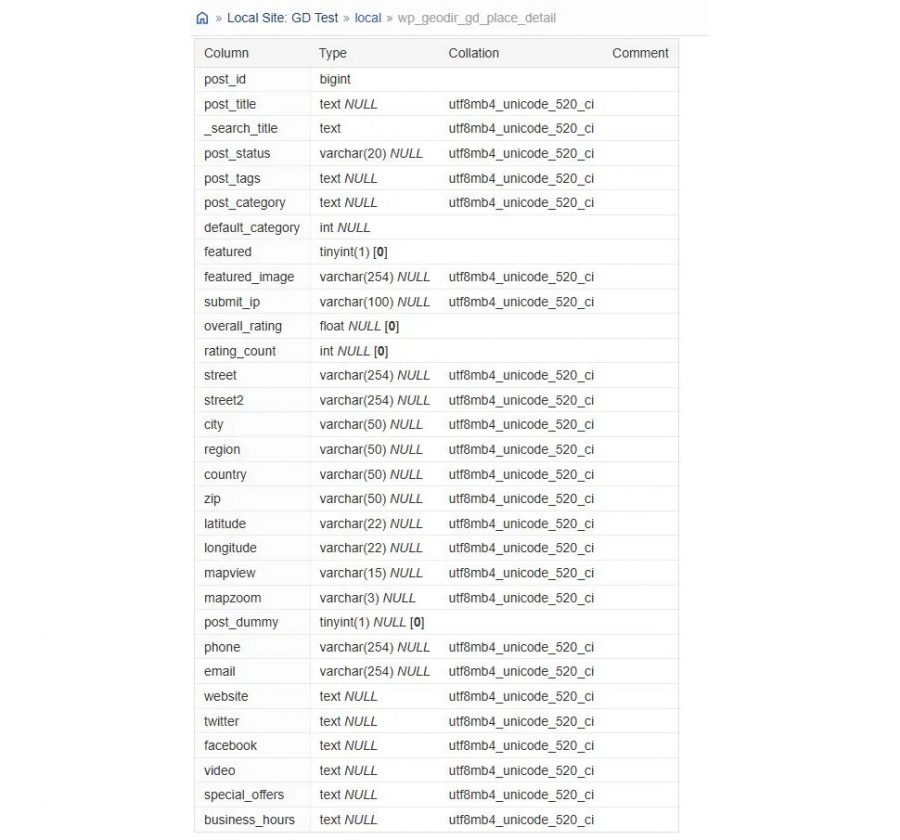
The main listings table (

wp_geodir_gd_place_detail
) has native columns for every property a listing has: title, status, tags, category, rating, street, city, region, country, zip, latitude, longitude, phone, email, website, social profiles, business hours, special offers, and more.
GeoDirectory Custom DB Table

There’s a separate _search_title column built specifically for fast keyword matching.

Custom fields live in their own table (wp_geodir_custom_fields).

Attachments are managed in a dedicated table outside the WordPress media library, which itself becomes a bottleneck at scale.

Reviews, sort fields, API keys, and tab layouts each have their own table.

Why this matters: a single SQL query against a proper table with indexed columns returns in milliseconds.

A search filtering by city, category, rating, and three custom fields runs as one query against one table with proper indexes, not as a cascade of joins.

The structure also means you can run an index on

city
,
country
,
latitude
,
longitude
,
overall_rating
, or any other column the directory queries frequently.

Native data types (varchar, int, float) are stored as their actual type, not serialized as strings. The query planner can do its job. The database can do its job.

Directorist’s post meta architecture

Directorist uses WordPress’s standard post meta table for listing data.

Every custom field, every taxonomy assignment, every searchable attribute lives as a row in

wp_postmeta
, keyed by post ID and meta_key.

This works fine at small scale because WordPress’s post meta query path is well-optimized for individual lookups.

It breaks at directory scale because directory queries aren’t individual lookups. They’re multi-attribute filters.

Searching for “restaurants in San Francisco with rating above 4 and outdoor seating and dog friendly and accepts reservations” runs five separate JOINs against post meta.

Each JOIN multiplies the query complexity. The database hits a wall.

We covered this in the Search Engine section: a search with five custom field filters runs five JOINs on the post meta table. Two filters might be fine. Four starts to lag. Six can lock the page.

That isn’t a guess. It’s how

wp_postmeta
works at scale, and it’s the fundamental constraint behind every “my directory got slow” support ticket directory plugin teams have ever received.

Map performance at scale

We covered the headline finding in the Maps section: GeoDirectory’s Marker Cluster add-on offers server-side rendering that handles up to 1 million markers with 300x less data than client-side equivalents.

Directorist’s Listings With Map uses client-side clustering, which works well at a few hundred markers and starts failing as the marker count climbs into the thousands.

The same architectural pattern repeats: GeoDirectory’s add-on assumes the directory will grow and pre-solves the problem. The competing approach assumes a normal-sized site and breaks when the assumption fails.

Caching

Both plugins are compatible with the major WordPress caching plugins.

GeoDirectory specifically recommends WP Rocket and FlyingPress as optimal, with most other caching plugins working well too.

Page caching, object caching with Redis or Memcached, and CDN integration through caching plugins all work as expected.

Map data has its own server-side cache built into the plugin, so repeat map loads don’t regenerate the marker dataset from scratch each time.

Pagination

Both plugins handle long result lists with pagination out of the box.

GeoDirectory supports AJAX pagination, so the page updates in place without a full reload, which keeps the synced map and listings layout fast as users navigate through results.

Both plugins integrate with modern theme pagination patterns.

Hosting recommendations

For a starting directory, Cloudways with Vultr High Frequency droplets gives you NVMe storage and modern CPUs at a reasonable price.

For directories at scale (tens of thousands of listings, real traffic), managed WordPress hosts like Rocket.net are built for the kind of database load directories generate.

Shared hosting is fine for testing but isn’t where production directories should run regardless of which plugin you choose.

What scale actually looks like

The largest GeoDirectory deployment we work with runs roughly two million listings under heavy traffic on a single $600/month dedicated server, with our ElasticSearch integration handling the search layer.

The site is for a major US SEO agency we can’t name due to NDA.

It performs comparably to a small Directorist demo running on a basic VPS, which gives you a sense of the architectural gap when both plugins are pushed.

We haven’t seen Directorist sites at that scale in production. We’d be genuinely curious to.

Our prediction is that at 50,000 listings with combined search filters and map rendering, the WordPress admin itself starts to struggle, not just the front-end.

That’s a testable claim, and we’ll be running a dedicated benchmark post comparing both plugins under identical load conditions in the coming weeks. We’ll publish the methodology and the raw numbers, no spin.

What this means for your directory

If your directory will stay under a few thousand listings, performance differences between the two plugins won’t matter much. Decent hosting and a caching plugin will paper over almost anything.

If you’re planning to scale (a national directory, a multi-city guide, a niche aggregator with high listing counts), the database architecture is where the future of your project is decided.

Custom tables with proper indexes scale. Post meta does not.

Everything else (maps, search, schema, mobile) sits on top of that foundation.


Security

Security is the section that gets glossed over in most plugin comparisons because it doesn’t sell features.

It should be the section directory owners read most carefully.

A directory holds business data, user accounts, payment information, and sometimes PII for years.

The plugin’s track record on security, and the team’s response when things go wrong, will outlast every feature comparison in this article.

Both plugins have had security vulnerabilities. Every WordPress plugin has.

The relevant questions are how many, how severe, how the team responded, and what the public record looks like. We’ll let the documented sources do the talking.

The vulnerability record

The National Vulnerability Database lists vulnerabilities for both plugins.

GeoDirectory has roughly 15 disclosed CVEs since the v2 release in 2018, the majority of them low-to-medium severity and difficult to exploit in practice.

Directorist’s record on NVD is more substantial in both count and severity.

The two key references for verifying both records:

Anyone reading this article can verify both lists for themselves. We’re not asking you to take our word for any of what follows.

November 2021: the fake ransomware campaign

In November 2021, security firm Sucuri documented an active attack campaign against WordPress sites running Directorist.

BleepingComputer, a major security news outlet, reported the incident in detail.

Approximately 291 WordPress sites were compromised, displaying fake encryption ransom notes demanding 0.1 Bitcoin (roughly $6,000 at the time) for restoration.

The technical details, per Sucuri and BleepingComputer: attackers exploited a vulnerability in the Directorist plugin to display ransom notes and modify all WordPress blog posts on affected sites, setting their post_status to null and making content invisible.

The plugin was being used as the attack vector. A patch was released as version 7.0.6.2.

Source: bleepingcomputer.com/news/security/wordpress-sites-are-being-hacked-in-fake-ransomware-attacks/

April 2023: critical vulnerabilities and the WordPress.org closure

In April 2023, the Wordfence security research team disclosed two critical vulnerabilities in Directorist affecting versions 7.5.4 and earlier:

  1. Arbitrary User Password Reset to Privilege Escalation. An attacker could reset any user’s password, including administrators, and gain full control of the site.
  2. Insecure Direct Object Reference leading to Arbitrary Post Deletion. An attacker could delete listings and other content without authorization.

At the time of disclosure, Directorist was installed on over 10,000 WordPress sites.

What happened next is the part that matters most.

On June 1, 2023, the plugin was closed by the WordPress.org plugin review team due to developer unresponsiveness.

That is, two months after the vulnerabilities were responsibly disclosed, the WordPress.org team forcibly removed the plugin from the public repository because the Directorist team had not yet shipped a working fix.

The plugin was eventually patched and restored to the repository 12 days later.

Directorist’s own blog post about the incident confirms the closure and the 12-day downtime. They framed it as a “precautionary measure” by WordPress.org, but the underlying reason WordPress.org closed the plugin was that the security team couldn’t get a timely response from the developer.

For directory owners running Directorist during those 12 days, this means the plugin was unavailable for new installations and updates from the official repository while a known critical vulnerability was being actively documented.

Sources:

Continuing incidents through 2025-2026

Severe vulnerabilities have continued.

Two examples documented in the public record this year:

The pattern across the public record: critical-severity privilege escalation and account takeover vulnerabilities, in both the core plugin and the paid extensions, multiple times across multiple years.

GeoDirectory’s response practices

We don’t claim to be vulnerability-free. We claim to respond fast and treat security as a priority on every release.

The full GeoDirectory vulnerability history is publicly searchable at the NVD link above.

What’s different about our process:

Response time. Our development team operates across timezones, which means when a security report hits our support system, someone on the team picks it up almost immediately. From confirmation to patched release, we target hours, not days. Most security patches we’ve shipped have moved from report to release within 12 hours.

Disclosure and bounties. We don’t run a formal bug bounty program, but when a researcher discloses a genuine vulnerability to us privately, we offer fair compensation on a case-by-case basis. We’ve never received a credible report we didn’t pay for.

External validation. Our CEO/CTO, Stiofan, is an active WordPress security researcher in his own right.

Public bounty records show him being awarded $1,250 by Wordfence in March 2024 for discovering a privilege-escalation vulnerability in miniOrange’s Malware Scanner plugin, and $2,063 in April 2024 for discovering a privilege-escalation vulnerability in the User Registration plugin (60,000+ active installs).

Those bounties are listed publicly on Wordfence’s blog.

Stiofan also contributed to the research behind the 2024 disclosure that led to two miniOrange plugins being permanently closed by WordPress.org, protecting over 10,000 sites.

That work was covered by The Hacker News, Techzine, GBHackers, and other security outlets.

The relevant point: the person responsible for security at GeoDirectory does this work professionally and publicly, on other people’s plugins, for bounty rewards from the industry’s leading WordPress security firm.

The same eyes scrutinizing other plugins are scrutinizing ours.

Repository status

GeoDirectory has never been closed by the WordPress.org plugin review team for security issues.

The plugin has shipped continuously from the repository since 2014.

What this means for buyers

We’re not going to tell you Directorist sites get hacked.

The latest version is patched, the team has shipped fixes, and using the current release should be safe under normal conditions. We’re not making predictions. We’re not in a position to.

What we are saying, and what the public record supports unambiguously:

  1. Directorist has a documented history of severe security incidents, including a 2021 attack campaign that compromised hundreds of live sites, a 2023 forced removal from WordPress.org due to developer unresponsiveness on disclosed vulnerabilities, and continuing CVSS 9.8 critical vulnerabilities in 2025 and 2026 in both the core and add-ons.
  2. GeoDirectory’s track record is meaningfully different. Fewer critical CVEs, a faster patch cycle, no repository closures, and a CTO with verifiable independent security research credentials.
  3. For a hobby site testing the directory model, this probably doesn’t matter much. For a directory holding user accounts, payment data, business information, or anything you’d be uncomfortable seeing on a breach forum, vendor security track record is a real input into the buying decision.

A directory is a long-term project. You’ll likely run this plugin for years.

The vendor’s behavior under pressure is part of what you’re buying. We’ve laid out the public record. Read it for yourself, and weigh it however you weigh it.


Multilingual

Both plugins target WPML as the primary translation solution, and both rely on a free companion extension to make their custom data structures translatable.

The two approaches are closer to feature parity here than in most sections.

WPML support

GeoDirectory ships a free WPML extension that handles 100% of the plugin’s translatable surface: listings, categories, locations, tags, custom fields, email templates, and front-end strings.

The custom fields piece required us to build the extension specifically because GeoDirectory stores custom fields in its own database tables rather than post meta, which means a generic translation plugin can’t reach them by default.

The extension exposes those fields to WPML’s String Translation module so they translate the same way native WordPress fields would.

Directorist also ships a free WPML integration plugin, with recent updates (Feb 2026) that fix translation issues with directory types, taxonomy data, front-end strings, and email translations.

The 2025 G2 reviewer’s complaint about Directorist’s WPML string translation breaking on updates appears to have been addressed by the recent patches.

Functional parity. Both work with WPML’s automatic translation engine for AI-assisted translation review, both support translated slugs and hreflang tags for SEO, and both let users translate listings either manually or through WPML’s machine-translation workflow.

Polylang, TranslatePress, Weglot

Neither plugin officially supports Polylang, TranslatePress, Weglot, or GTranslate.

Some of these work partially through generic WordPress translation hooks, but neither vendor maintains a dedicated integration.

If you’re committed to a non-WPML translation plugin, expect to do custom integration work on either side.

Multi-currency

For directories that charge for listings, claims, or bookings, multi-currency support matters as much as language translation.

GeoDirectory’s GetPaid plugin (free for the base, paid for the Multi-Currency add-on) handles this natively, letting visitors see prices in their local currency with automatic conversion.

Directorist’s Pricing Plans extension supports a single currency per site without a dedicated multi-currency layer.

For directories operating in one country, this is a non-issue on either side. For a directory targeting a multi-national audience with paid listings, the multi-currency gap is real.

RTL languages

GeoDirectory supports right-to-left languages (Arabic, Hebrew, Persian) out of the box, with RTL-ready templates.

Directorist offers similar RTL support in their core templates.

The multilingual reality

For most multilingual directory projects, WPML is the answer regardless of which plugin you pick.

Both teams have built the integration their respective plugins need, both keep it updated, and both work with WPML’s standard translation workflow.

The actual differentiator is multi-currency support for monetized directories, where the GeoDirectory + GetPaid stack handles it natively while Directorist doesn’t.


User Friendliness

This is the section where Directorist genuinely wins more than it loses, and we’re not going to pretend otherwise.

Out-of-the-box ease of use is one of their real strengths, and one we’ve watched users respond to.

Setup flow

Both plugins are similar at the install-to-first-listing step. A few minutes either way.

Neither requires technical knowledge to get a basic directory standing. The differences show up once you go past the defaults.

Admin UX and settings density

GeoDirectory has more settings than Directorist. That’s both a strength and a liability.

Power and customization depth come with more options to navigate, and we’ve been honest internally that some of those options are convoluted or hard to find.

The current admin has a “Show/Hide advanced” toggle for exactly this reason: to hide the rarely used settings so the everyday ones aren’t buried in a long scroll.

Directorist’s admin is leaner. Fewer settings to wade through, fewer paths to the same destination, and the Directory Builder approach we covered in Design & Customization keeps much of the configuration visible rather than scattered across settings pages.

For a non-technical site owner setting up their first directory, this lower-friction admin is a genuine advantage.

Documentation and video tutorials

GeoDirectory’s written documentation is comprehensive (wpgeodirectory.com/documentation/), covering both core and add-ons in depth.

The gap is video. We don’t have a deep official video tutorial library, which is a real complaint we hear from users who learn better visually.

One of our support agents runs a YouTube channel with tutorials he’s built for his own customization and development clients, with our blessing, but it isn’t an official replacement for what a comprehensive video library would offer.

We’re working on closing this gap.

Directorist has invested heavily in video content. YouTube tutorials, walkthroughs, marketing-flavored explainers, the lot.

For a learning style that prefers video over text, Directorist’s content library is easier to land on.

The learning curve

The single most common piece of negative feedback we hear from non-technical users is that GeoDirectory takes time to learn.

The template page approach gives developers infinite flexibility, but for someone who’s never edited a page template before, it can feel abstract until it clicks.

Developers and seasoned WordPress users describe the same architecture as the reason they chose GeoDirectory. Same feature, different audience, different reaction.

Directorist’s Directory Builder is more guided. You see a layout, you toggle widgets on or off, you reorder them, you preview, you save.

Fewer concepts to learn, faster to the first working result. The ceiling is lower, but the entry ramp is gentler.

What’s coming in v3

GeoDirectory v3 will be AI-native, meaning non-technical users can describe their directory to a chat interface (Claude, ChatGPT, or similar) and have it built from that conversation.

The goal is to make GeoDirectory’s depth accessible without forcing every user to learn the template architecture first.

We’ll have more to share on this as v3 gets closer.

The honest trade-off

For ease of use, Directorist wins today.

Their admin is cleaner, their video library is more developed, and their builder approach is more forgiving for non-technical users. We’re not better than them on this dimension.

What we’d ask any reader to weigh is whether ease of use today is the right thing to optimize for.

The plugin you install in an afternoon is the plugin you’ll run for years.

The depth you can’t unlock now is the depth you’ll wish you had once your directory has real listings, real revenue, and real custom design needs.

Easier upfront, harder to grow into. That’s the trade-off, and reasonable people will pick different sides of it depending on what they’re building.


Developer Extensibility & Integrations

Both plugins are built with developers in mind, and both ship the standard WordPress extensibility surface: action hooks, filter hooks, REST API, template overrides via child themes.

This is one of the closer-to-parity sections in the article.

Hooks, filters, and REST API

GeoDirectory exposes hooks and filters across the full plugin lifecycle.

Listings, custom fields, search, maps, reviews, payments, emails, the lot. If a needed hook is missing, we add it on request.

The REST API covers every data action you’d perform through the WordPress admin UI, which means a custom application can create, read, update, and delete listings, manage users and categories, and trigger most workflows without touching the WordPress interface at all.

Directorist offers a similarly extensive hook system. Their REST API exposes the main endpoints for listings, users, categories, reviews, and media.

Both plugins are extensible. Both have the developer documentation you’d expect.

For developers who’ve worked with one and need to integrate with the other, the patterns are familiar on both sides.

Neither plugin is unusually restrictive or unusually open. Both are workable.

Page builders

GeoDirectory is fully compatible with Elementor (and Elementor Pro), Bricks Builder, Divi, Beaver Builder, Oxygen, Breakdance, SiteOrigin, Avada Fusion Builder, and the WordPress block editor.

For Elementor Pro and Bricks specifically, GeoDirectory integrates with their dynamic content systems, which means you can use the page builder’s elements with GeoDirectory’s data structures.

We have official tutorials and remote templates for both.

Divi recommends GeoDirectory in their roundup of best WordPress directory plugins and has published tutorials on building a directory with Divi and GeoDirectory.

A third-party developer (divigeo.com) maintains a dedicated GeoDirectory child theme for Divi users, which indicates an active developer ecosystem around the plugin.

Directorist ships 25+ purpose-built widgets for Elementor, along with similar widget sets for Bricks and Oxygen.

The catch is that these are opinionated, prebuilt widgets that render Directorist’s own designs.

They don’t expose Directorist’s listing data to the page builder’s native dynamic content system, which means designers using Elementor Pro, Bricks, or Oxygen can’t build custom layouts pulling Directorist fields the way they would with WooCommerce or other dynamic-data-aware plugins.

GeoDirectory takes the opposite approach: we integrate directly with Elementor Pro’s and Bricks’ dynamic data systems, so every custom field, location, rating, and listing attribute is available to the builder’s native elements.

Designers can build any layout they want with the page builder’s own tools, using GeoDirectory data as the source.

Theme compatibility

Both plugins work with any theme that follows WordPress best practices. Neither requires a specific theme.

Both ship their own optional theme: GeoDirectory’s Blockstrap is a full Site Editing (FSE) theme purpose-built for the plugin, with the best performance pairing we’ve measured.

Directorist’s Onelisting theme is free and tailored to their layout patterns.

For users who want a starting point that “just works” with the plugin’s design assumptions, both options exist.

Community plugins (BuddyPress and BuddyBoss)

Both plugins integrate with BuddyPress for social-network-style community features.

BuddyBoss officially lists both plugins as integrations at buddyboss.com/integrations/, recommending GeoDirectory and Directorist independently.

For directories that want to add social features (member profiles, activity feeds, groups, messaging), either plugin will fit into a BuddyBoss-driven site.

Third-party plugin ecosystem

GeoDirectory’s official partner ecosystem includes UsersWP (user profiles and dashboards, made by us), WP GetPaid (payments, made by us), Ninja Forms (custom forms), AffiliateWP and SliceWP (affiliate management), WP All Import (CSV import workflows), Yoast SEO and Rank Math (SEO), BuddyPress, and, through the GeoMarketplace add-on, WooCommerce paired with the major multi-vendor plugins (Dokan, WCFM, WC Vendors Pro, MultiVendorX).

GeoMarketplace turns each listing into its own WooCommerce shop, where listing owners sell products and the directory admin earns a commission on every sale, with proximity-based product search so users can buy from the shop nearest to their location.

Use cases range from restaurant directories with menu items for delivery to Etsy-style marketplaces to local thrift store networks.

Directorist’s ecosystem includes its FormGent integration, several multi-vendor plugins (Dokan, WC Vendors, WCFM), and integrations with Mailchimp, Stripe, and PayPal.

Their multi-vendor support stops at letting vendors manage their own listings. There’s no proximity-aware product search layer on top.

The honest summary

For developer extensibility and integrations, both plugins reach the same destination by different routes.

Both ship hooks, filters, REST APIs, and template overrides. Both work with the major page builders and the major multi-vendor plugins.

The differentiator that matters most for design and development work is GeoDirectory’s native dynamic data integration with Elementor Pro and Bricks, which gives designers full control over layout instead of locking them into prebuilt widgets.

The differentiator for ecommerce-driven directories is GeoMarketplace’s proximity-based shop and product search, which has no equivalent on the Directorist side.


Import / Export & Migration

GeoDirectory Import/Export Tool

Moving data in and out of a directory is one of those features that doesn’t matter at all until the day you need it badly.

Both plugins ship CSV import and export in their free versions.

The differences show up in what’s importable, what’s exportable, and what happens when you want to move from another plugin entirely.

CSV import in the free version

GeoDirectory’s free importer covers more than just listings.

The Import/Export panel handles Listings, Categories, Reviews, Settings, Post Types, Custom Fields, CPT Tabs, Locations, Locations + CPT Description, and Category + Locations Description.

That last item matters: it lets you bulk-import the editorial content that sits above and below location and category archives, which is the foundation of the pSEO listicle approach we covered in the SEO section.

The free importer also handles bulk edits via re-import. Change the data in your CSV, re-upload it, and the existing listings will update in place.

That sounds small until you actually need it.

You added a new custom field and have to populate it across 30,000 existing listings. You restructured your categories. You fixed a data entry error that propagated across thousands of rows. You want to bulk-update business hours after a holiday calendar change.

Without re-import, your options are: edit each listing manually through the admin (impossible at scale, especially on a directory that’s already slow under load), write custom SQL or a migration script (out of reach for 99% of directory owners), or delete all listings and re-import from scratch (which breaks every internal link, every saved search, every external link, every Google indexed URL, every review attached to the existing post IDs).

Directorist’s importer is currently add-only, which means none of those options has a clean exit.

We covered this in Features Comparison, but it’s worth restating here because import/export is precisely the section where this gap matters most.

For power users who prefer WP All Import’s interface, GeoDirectory is fully compatible. Directorist supports its own importer, plus CSV mapping for custom fields.

CSV export

GeoDirectory’s exporter mirrors the importer. Anything you can import, you can export.

Filtering is built in: pick the post type (Places, Events, or any CPT you’ve added), set a max entries per CSV file (5,000 default), and filter by published date range.

Useful for backups, migrations, or external data processing.

Directorist exports listings via CSV with similar mapping capabilities.

Migration from other directory plugins

This is where the gap widens.

GeoDirectory ships a free Directory Converter plugin that migrates listings from competing directories directly into GeoDirectory’s database.

Supported sources include phpMyDirectory, Listify, Business Directory Plugin (6.3+), eDirectory, Vantage Directory Theme, and Directorist (7.9.0+).

That last one matters in context. Directorist users who outgrow the plugin’s architecture can move to GeoDirectory without rebuilding their data.

The converter is in beta and intended for staging use, but it does the heavy lifting of mapping field structures across plugins.

Directorist doesn’t ship an equivalent converter for incoming migrations from competing plugins.

Their migration story is “import via CSV,” which is fine if you have a clean CSV ready and not so fine if you’re trying to preserve metadata, taxonomies, and custom field structures across systems.

Migration to other plugins

GeoDirectory doesn’t actively help users leave for other directory plugins. We don’t do custom migration work and don’t ship a “GeoDirectory to X” converter.

That’s intentional.

The exported CSV is open and complete, so anyone determined to leave has the data to do it.

Backup compatibility

Both plugins are compatible with standard WordPress backup plugins (UpdraftPlus, BlogVault, WP Vivid, BackWPup, others).

Standard backup plugins capture the entire database, so GeoDirectory’s custom tables are backed up alongside the standard WordPress tables. No special configuration needed.

The migration reality

For day-to-day import/export, both plugins handle the basics.

The two operational wins for GeoDirectory are bulk-edit via re-import (a real difference once a directory has more listings than you can manage by hand) and the Directory Converter for migrating from competing plugins.

Neither has a Directorist equivalent. For directories planning to grow and possibly switch tools later, the GeoDirectory side is friendlier to data portability in both directions.


Support, Documentation & Reputation

GeoDirectory Support Stats

This section is the one most comparison articles skip. Buyers reading them shouldn’t.

A directory plugin is a long-term relationship. You’ll run it for years, write support tickets when something breaks, and rely on the team to respond.

The plugin’s track record on support and the team’s behavior when things go wrong will outlast every feature comparison in this article.

Both companies have been around long enough to have a public record. We’ll show ours, then show theirs, then send you to read both for yourself.

Support channels

GeoDirectory offers two paths to support. Free users can post in the WordPress.org plugin forum or open a ticket via our email-based ticketing system.

Paid customers use the ticketing system exclusively.

We commit to a 24-hour response window. We rarely take that long. Our actual numbers from the ticketing system, current reporting period:

Roughly one in five tickets gets a first response inside 15 minutes. The promise is 24 hours. The reality is that most tickets are handled in an afternoon.

Directorist runs a similar model: WordPress.org forums for the free plugin, a separate ticketing system for paid customers.

They don’t publish comparable real-world response metrics that we’ve found.

Documentation

GeoDirectory’s written documentation is comprehensive, covering core and add-ons in depth.

The gap is video. We don’t have a deep official video library, and we said as much in the User Friendliness section.

Directorist has invested heavily in video tutorials. For learners who prefer video over text, Directorist’s content is easier to land on.

Team and continuity

GeoDirectory has been around for 12 years as a plugin, with the team, rooted in GeoTheme.com, dating back 14 years.

Stiofan and I founded the company and remain co-CEOs, with Stiofan serving as CTO and me as CMO. The core team is distributed across India, Kenya, Australia, and Bali, and has been together since 2014 with minimal turnover.

Continuity matters more than most directory owners realize until they’ve watched a plugin change hands and lose its direction.

Reputation

This is the part of the section where most comparison articles either go quiet or go scorched-earth. We’re going to do neither.

The numbers on WordPress.org as of this writing:

Comparable on the surface. The story under the surface is where it gets interesting, and it’s a story you should read for yourself rather than take our word for.

Our own track record, the honest version

GeoDirectory has 29 one-star reviews on WordPress.org.

Almost all of them are clustered around a specific period: the V1-to-V2 transition, plus a handful of earlier and later issues.

We have not received a one-star review since May 2022, which is almost four years ago. Before that, we had another roughly two-year gap.

We hope to extend the current streak indefinitely, but reviews are a natural part of running a software product, and we don’t pretend otherwise.

Here’s the part that’s harder to write.

When we read those old reviews now, we cringe. We did not handle pressure well in that era.

We took criticism personally and answered in ways we should not have. Sometimes we were right on the technical merits and wrong on the tone. Sometimes we crossed lines.

We can’t edit those responses. WordPress.org doesn’t allow it, and even if it did, pretending the responses don’t exist would be a worse problem than leaving them up.

What we can do is point to the timeline. The change in how we respond happened years ago.

The current approach is documented in our recent forum and ticket history, which is also public.

If you want to see what we used to look like, read our old one-star threads. If you want to see what we look like today, read the recent forum activity.

Both are public. Both are searchable side by side.

If there’s a lesson in our old reviews, it’s how not to manage criticism as a software vendor. We learned it the hard way.

We’re sharing it openly because hiding it would be both dishonest and ineffective.

Directorist’s current pattern, documented

Directorist’s recent reviews tell a different story, and the pattern is current rather than historical.

In November 2024, a verified Directorist user (see screenshot: digitronic) wrote a one-star review titled “What used to be a decent directory plugin got botched with the major update”.

The review included this specific complaint:

“Asking for a positive review as a condition for the support to be provided, is a no no, and no serious company that advocates customer love should be engaging in such practices.”

Directorist’s official response from their plugin support staff: “We also want to address the mention of positive review requests. Please rest assured that support agents do not ask for positive reviews as a condition for offering assistance.”

A clear public denial.

In March 2025, four months later, a different user (see screenshot: Adam, @servicesportal) posted a separate review titled “A Terrible Three-Year Experience” that opened with this:

“First of all, I want to say that when you contact the support team, the developers ask you to leave a positive review about them. Otherwise, they refuse to provide consultation on their free plugin. Secondly, I had previously left a negative review, after which the support team personally messaged me and asked me to delete it.”

Two separate accusations: positive reviews traded for support, and private outreach asking him to delete a negative review.

Directorist’s response this time did not deny either accusation.

The reply asked him to “submit a support ticket detailing all the issues you’re facing. Please also mention the review you left so we can identify your case and follow up accordingly.”

The framing matters. The earlier response (November 2024) explicitly denied the behavior. The later response (March 2025) sidestepped it and asked the user to identify himself by his review.

Independent users, four months apart, reporting the same pattern. The denial in one thread and the non-denial in the other speak to the credibility of the underlying claim.

Two further one-star reviews worth reading in this context: “Unusable 7.4” and “After 3 years still not working”.

Both are public on the WordPress.org Directorist reviews page.

Neither alone proves a pattern. Together with the two threads quoted above, they describe a vendor relationship that some users have found difficult enough to come back to a public forum to document.

The AI marketing problem

The plugin’s full name on WordPress.org is “Directorist: AI-Powered Business Directory, Listings & Classified Ads.”

The readme opens with “Powered by AI.”

The pricing page, the homepage, and the YouTube thumbnails all heavily market the AI angle.

Their own dedicated AI landing page tells a different story.

AI Powered or not?

The headline product, “Directorist AI (Pro),” carries a “Coming Soon” label, and the body literally reads: “That’s exactly what we’re building, and it’s dropping soon.”

The plugin, marketed as AI-powered, is selling a feature that hasn’t been released.

When called out by one of their users in a negative review, they replied that the Directory Builder is AI-powered.

We looked into it.

The one AI feature that does ship in the current plugin is a “Create with AI” option in the directory setup flow.

The plugin sends the user’s prompt to the directorist server, where it is processed, and returns suggested categories and form fields.

There’s no model running locally, no API key configuration, no provider selection.

The hardcoded endpoint URL is right there in the plugin code at line 20 of includes/modules/multi-directory-setup/class-ai-builder.php.

What model is on the other end?

Their support team has said publicly that it’s Llama. We have no way to verify that from the plugin code, since the model is hidden behind their server.

It could be Llama. It could be something else. It could be a rule-based template engine. The plugin can’t tell you.

Two things stand out beyond the model question.

The broader AI features Directorist advertises across its site aren’t actually shipped yet.

Their own support staff confirmed this in the WordPress.org forums, stating that advanced AI functionality is part of “phase two” and hasn’t been released publicly.

The AI Builder also sends user-entered data (your directory description, your business name, whatever prompt text you type) to an external server with no opt-in checkbox, no consent prompt, and no disclosure in the plugin readme about what gets sent or where.

For some teams, that’s a non-issue.

For teams working with client data, internal launches, or anything under GDPR, it’s worth knowing about before you build on top of it.

We’re not telling you the AI feature is bad. We’re telling you that what’s marketed as a present-tense AI-powered product is, on their own dedicated AI landing page, labeled “Coming Soon.”

The gap between marketing and reality is part of the trust question this section is about.

The deeper question

Both companies have been around long enough to be judged on the public record.

The question for a directory owner choosing between them isn’t who’s had bad reviews. It’s what each company does when bad reviews come in.

We had a period of handling pressure badly. The record shows that the period ended years ago.

We changed our approach, the support we ship today reflects that change, and the absence of one-star reviews for four years is one indicator of how that shift landed.

Directorist’s track record on the public forum is open to interpretation. The two recent threads we quoted are linked above for anyone who wants to read them directly.

If you want a broader view, the first few pages of their reviews are also public.

Some of what’s there is the normal frustration any plugin team accumulates over time. Some of it describes patterns that are harder to wave away.

We’re not telling you Directorist’s support is bad. We’re not telling you ours is perfect.

We’re telling you the public record is right there. Read it for both plugins, take whatever weight you give to user-reported behavior at vendors, and decide accordingly.


Pricing and TCO

Both plugins are free to install. Real directories need more than that.

This section is about what you actually pay over a year, three years, and five years to run a directory in production.

Free tier capability

Run GeoDirectory free plus our companion plugins GetPaid (free, payments) and UsersWP (free, user profiles and dashboards), and you can ship a real directory that earns money.

A city guide that sells eBooks. A directory that sells branded merch. The free stack is a working business, not a demo.

For more advanced cases like paid registration for a members-only directory, you’ll need the UsersWP Membership plugin, which moves you out of the free tier.

Directorist’s free tier is similar in spirit. Featured listings with offline bank transfer payment are included in the free plugin.

To unlock real monetization (Stripe, PayPal, recurring subscriptions, tiered pricing plans), you need paid extensions on either side.

GeoDirectory pricing

Three membership tiers, each including every GeoDirectory add-on we make:

Every membership includes the full add-on library, premium support, and updates for the term.

Renewals are at the same rate you signed up for. No price increase on renewal. No price decrease either.

You pay what you paid the first year for as long as you stay subscribed.

We don’t offer lifetime deals. We’ve watched too many WordPress plugin teams collapse under the math of selling once and supporting forever.

We’d rather charge a fair annual price and still be here in five years than vanish chasing a one-time bump.

30-day money-back guarantee on every plan.

Directorist pricing

Three tiers, similar packaging:

There’s also a Lifetime tier on a separate tab.

The perpetual discount problem

Perpetual Discount that never goes away is no discount

You’ll notice every Directorist tier above shows a strikethrough “regular” price next to a “Save 15-35%” discount.

We’ve checked over time. The discount is always there; sometimes the % changes, but the full price is never the price anyone pays.

Every visit to their pricing page shows a sale.

This is a marketing tactic, not a real discount.

It’s also illegal in the UK under the Consumer Protection from Unfair Trading Regulations 2008, which prohibit displaying a “from” or “was” price that hasn’t been the actual price for a meaningful period.

Fines can reach 10% of global turnover for repeat offenses.

We don’t run perpetual sales because we’d rather not violate consumer protection law in our home market. The price you see for GeoDirectory is the price.

The other thing to look at is the renewal column. The Directorist renewal prices in the screenshot differ from the first-year prices.

Some plans renew lower, others renew higher. Worth checking the small print of whichever tier you’re considering before assuming the discount continues.

Total cost of ownership over three years

The headline numbers don’t capture what you actually pay.

Here’s a fairer view, assuming you stay subscribed for three years and run a directory that needs the core add-ons either plugin offers.

GeoDirectory unlimitedDirectorist Agency
Year 1$229$142
Year 2$229$131
Year 3$229$131
3-year total$687$404
Difference-$283

Directorist is meaningfully cheaper over three years, and we won’t pretend otherwise.

The question is what you get for that delta and what you don’t get.

What’s included for $283 less:

What you get for that delta:

Hidden costs to factor in

Hosting is your choice on both sides. Neither plugin requires specific hosting, but a directory at any real scale won’t run well on $5/month shared hosting.

Budget realistically for that, regardless of which plugin you pick.

GetPaid’s premium payment gateways (Mollie, Razorpay, GoCardless, others beyond Stripe, PayPal, Authorize.net, and bank transfer) are paid add-ons if you need niche regional gateways.

Directorist’s gateway extensions (Stripe, PayPal, Authorize.net) are paid separately at roughly $39 each unless bundled into a higher tier.

For most directories, the gateway costs roughly cancel out.

The CTA

Membership at $229 per year for unlimited sites is the GeoDirectory version we recommend to anyone serious about building a directory.

It includes every add-on we make (Location Manager, Pricing Manager, Marker Cluster, Advanced Search, Events, MultiRatings, Franchise Manager, Claim Listings, Compare Listings, GeoMarketplace, Dynamic User Emails, Saved Search Notifications, Embeddable Ratings Badge, and the rest), premium support, and price-lock for as long as you stay subscribed.

The 30-day money-back guarantee gives you a full month to verify that everything in this article applies to your specific use case.

Get GeoDirectory Membership


Final Verdict

We’ve spent 20 sections laying out the comparison in detail. Here’s where it lands.

For most readers of this article, the choice isn’t close.

GeoDirectory is the better long-term plugin in terms of architecture, security, performance, SEO, and team behavior over time.

Every section above documents this in a different way. None of it is opinion. All of it is sourced.

For one specific case, Directorist is a defensible choice.

If you’re running the lowest-stakes possible project, a hobby directory with a handful of listings, no plans to grow, no plans to charge users, no plans to be in the index for any “X in Y” query, no concern about a vendor’s security track record because the directory won’t hold real user data, and a hard preference for the cheapest possible first-year cost, then Directorist gets you to a working site faster and cheaper.

The visual Directory Builder, the multi-directory free tier, the lower entry price, and the bigger video tutorial library all genuinely help in that scenario.

That scenario covers a small slice of the people who land on a “best directory plugin” search. For everyone else, the picture is different.

If your directory grows beyond a few hundred listings, the architecture matters. GeoDirectory’s custom database tables hold up under load. WordPress post meta doesn’t.

If your directory needs to rank for location-category combinations (“restaurants in San Francisco,” “lawyers in Manchester,” anything similar across a region or country), GeoDirectory’s location hierarchy is built for it. Directorist’s flat taxonomy isn’t.

If your directory will hold user data, payment info, or business records you’d rather not see on a breach forum, GeoDirectory’s security track record, response cadence, and CTO with verifiable independent bounty work are the foundation you want under your project. Directorist’s documented incidents and forced repository closures speak for themselves.

If you plan to monetize seriously, the GeoDirectory ecosystem (Pricing Manager, Pay Per Lead, Dynamic User Emails, Booking Marketplace, GeoMarketplace with proximity-based product search) covers paths Directorist doesn’t.

If you care about vendor behavior, the documented pattern on the WordPress.org forums tells you what to expect when something goes wrong.

The $283 price difference over three years is real.

The question is whether $283 over three years buys you something worth having when measured against everything in this article.

We think it doesn’t, but we have skin in the game and we’ve said so since the first paragraph.

The evidence behind every claim is linked, the third-party sources are public, and the reviews are on WordPress.org. We’ve made the case. The decision is yours.

If you reach the same conclusion we did, GeoDirectory Membership is $229 a year for unlimited sites, every add-on, premium support, and a 30-day money-back guarantee. We’ll be here when you need us.


Closer

If you got this far, thank you.

Comparison articles aren’t usually worth an hour of anyone’s time. We tried to make this one worth it.

We know we’re asking you to trust a vendor’s perspective on a competitor. That’s a hard thing to ask.

We’ve tried to make it easier by sourcing every claim, linking every quote, owning our own past, and writing the article we wished existed before someone forced us to write it ourselves.

If you have questions about anything in this article, anything we got wrong, anything you’d push back on, we’re around.

You’ll find us in the WordPress.org forums under the GeoDirectory plugin, in our support ticketing system if you’re a customer, and on the contact form at wpgeodirectory.com.

Stiofan and I read most of what comes in, and we answer it.

Whatever you decide to build, we wish you good luck with it.