Directory Starter Theme – Overview

Introduction:

If you are planning to create a location-based directory site, then you’re on the right track.

Directory Starter is a theme specifically designed for GeoDirectory plugin. Please note that GeoDirectory plugin is Optional. If you need just a simple WordPress theme for your blog, you can use Directory Starter theme without GeoDirectory plugin.

But if you would like to unleash the full potential of this theme, then you should definitely use this theme with GeoDirectory Plugin.

Note: This documentation assumes that you have a fresh WordPress installation.

GeoDirectory:

GeoDirectory is a free WordPress plugin that offers all the basic features you need to create a location based directory site. With its premium addons you can get additional features like “Paid Listing”, “Multiple Ratings” etc, but addons are not mandatory.

GeoDirectory has been downloaded more than 75000 times and its the best Directory plugin available for WordPress.  GeoDirectory is in this Geolocation business for a long time and it has dedicated support staffs.

If your website is gonna be a serious business for you, then you need serious people who can back you up. So GeoDirectory plugin will be your perfect choice.

Links

Demo:

We have created a demo site to show you the demo of Directory Starter theme. Demo uses our GeoDirectory plugin and its addons.

http://wpgeo.directory/starter/

Directory Theme Installation:

  1. Navigate to Appearance > Themes > Add New
  2. Enter “Directory Starter” in search box
  3. Install it
  4. Activate it

Menus:

  1. Go to Appearance > menus
  2. Create 2 menus. Name it “Primary Menu” and “Footer Links”.
  3. Make sure you assign those 2 menus to the theme menu locations using checkbox.

Settings:

Heads Up: Directory Theme uses wordpress built-in customizer feature for settings. So it doesn’t have a different settings page.

For example, To upload logo navigate to Appearance > Customize > Header > Logo

Here are the list of settings available

  1. General
    1. Site Identity
      1. Contains settings like Site Title, Tagline and Favicon
    2. Spacing
      1. Contains setting like Desktop Container Width and Padding
    3. Static Front Page
      1. Same setting you found in Settings -> Reading
    4. Alert Colors
      1. Alert box color settings available here.  These settings will be useful when BuddyPress installed. ( Oh yes.. Did we say that our theme is compatible with BuddyPress plugin? )
    5. Button Colors
      1. The primary button color settings available here
  2. Header
    1. Logo
      1. As you might have guessed, you can upload your site logo from here
    2. Header Image
      1. If you need an image as header background you can use this setting.
    3. Text Colors
      1. All header text color settings available here
    4. Background Colors
      1. All header background color settings available here
    5. Spacing
      1. All header height, padding, margin settings available here
  3. Body
    1. Background Image
      1. If you need an image as main content background you can use this setting.
    2. Text Colors
      1. All main content text color settings available here
    3. Background Colors
      1. All main content background color settings available here
    4. Typography
      1. Font settings like font family, font size available here
  4. Footer
    1. Background Colors
      1. All footer background color settings available here


    1. Spacing
      1. All footer related padding setting available here
    2. Copyright text
      1. You can change your site’s copyright text here
  1. Menus
    1. Menu Locations
      1. Primary Menu
        1. This is the menu you found in header
      2. Footer Links
        1. This is the menu you want to display near copyright text. When this menu not available copyright text will be centered. Else copyright text will be float left
  2. Widgets
    1. Contains your widget list


Using it with GeoDirectory:

Installation:

  1. Navigate to Plugins > Add New
  2. Search for GeoDirectory – Ultimate Business Directory
  3. Install it

Links

Configuration:

  1. GeoDirectory needs at least one location in order to work. So Set a default location first.
    1. To set default location, navigate to Geodirectory > Set Default Location
    2. Enter a city. Ex: New York, then click “Set Address on Map” button
    3. Save it
  2. If you would like to install our dummy data, navigate to Geodirectory > General > Dummy Data
    1. Choose the number of listings you need, then click “Insert Sample Data Please” button
  3. Set the home page to display “GD Home Page”
    1. To set home page, navigate to Settings > Reading
    2. “Front page displays” should set to “A static page”. Select “GD Home Page” for “Front Page”
  4. All widgets are automatically created by GD plugin. But we need to reorder home map and popular category widget for “Directory Starter” theme.
    1. So navigate to Appearance > Widgets
    2. Expand “GD Home Top Section”
    3. Re-Order the widgets in the following order. Just drag.
      1. GD > GMap Home Page
      2. GD > Popular Post Category
      3. GD > Search
  5. Would you like to add Add listing ( Ex. Add Hotel ) and View Listing ( Ex. Hotels ) links to the Main Menu? If Yes Navigate to Geodirectory > Design > Navigation > Show geodirectory navigation in selected menu locations > Select Primary Menu (This is the menu you created earlier)

Optional GeoDirectory Addons:

  1. GeoDirectory Custom Post Types
  2. GeoDirectory Advance Search Filters
  3. GeoDirectory Review Rating Manager
  4. GeoDirectory Location Manager
  5. GeoDirectory Marker Cluster
  6. GeoDirectory Payment Manager
  7. GeoDirectory Claim Manager
  8. GeoDirectory Events
  9. GeoDirectory AffiliateWP Integration
  10. GeoDirectory Ajax Duplicate Alert
  11. GeoDirectory BuddyPress Integration
  12. GD Booster
  13. GeoDirectory ReCaptcha
  14. GeoDirectory Social Importer
  15. Stripe Payment GeoDirectory Add On

Heads Up!

We have given small description, simple configuration and usage info for each plugin. Please note the configuration explained here is the minimal configuration your plugin requires in order to work.  So not all settings explained in this documentation. You can visit individual plugin documentation page for full configuration information.

Geodirectory Custom Post Types:

By default Geodirectory ships with only one generic post type called Places. But there are situations where you would like separate the listings by post type. An example would be, you have a automobile listing website where you list cars and bikes. It would make sense if you have a separate post type for Cars and separate post type for Bikes. In such cases, this plugin will help you.   

Installation:

  1. Visit wpgeodirectory.com ( Buy a subscription if Required )
  2. Navigate to My Account > Downloads ( Login if Required )
  3. Download Geodir Custom Posts zip file.
  4. Go to your WordPress site dashboard, Navigate to  Plugins > Add New > Upload Plugin
  5. Browse and Upload the zip file you downloaded from wpgeodirectory.com
  6. Activate the plugin.

Links

Configuration:

If you want the new post type links to appear in homepage navigation menu, then make sure to check the settings in Geodirectory > Design > Navigation after creating the post type.

Usage:

  1. Navigate to Geodirectory > Custom Post Types > Add Post Type
  2. You can keep the default fields as it as, but make sure you fill the following fields
    1. Post type
      1. Lowercase, Singular.  Ex: hotel
    2. Listing slug
      1. Lowercase, Plural. Ex: hotels
    3. Order in post type list
      1. Integer. Ex: 10
    4. Name
      1. Title Case, Plural. Ex: Hotels
    5. Singular name
      1. Title Case, Singular. Ex: Hotel
  3. Save it.
  4. If you don’t need any location support for this post type, navigate to GeoDirectory > General
    1. Select the post types for this setting. Select CPT to disable physical location

Geodirectory Advance Search Filters:

With this addon you can create unlimited search filters. When activated, this plugin adds a button called “Advanced” near “search” button. When you click “Advanced” button, it will display all search filters. A practical example would be, you have a job website and you would like to offer users some option to filter the search results with option like “Min Experience”, “Min Salary” etc. So they can narrow the search results.

Installation:

  1. Visit wpgeodirectory.com ( Buy a subscription if Required )
  2. Navigate to My Account > Downloads ( Login if Required )
  3. Download Geodir Advance Search Filters zip file.
  4. Go to your WordPress site dashboard, Navigate to  Plugins > Add New > Upload Plugin
  5. Browse and Upload the zip file you downloaded from wpgeodirectory.com
  6. Activate the plugin.

Links

Configuration:

No configuration needed.

Usage:

  1. Navigate to Geodirectory > Place Settings -> Custom Fields
  2. You can add existing custom fields in advanced search or you can create a new custom field and then include in advanced search.
  3. To add existing custom field (Ex: Category), just expand the field by double clicking it and then make sure you checked “Include this field in filter” option, which is available under “Advanced sort & filters options” section.
  4. To add a new custom field, just click the type of field you would like to add from the left side, fill the necessary options and then save it.
  5. Once you checked “Include this field in filter” option, that field will be available on the next tab (Advance Search)
  6. Click the field, you would like to display in advance filters,  enter the front end title and then save it.
  7. Repeat the steps to add more fields.
  8. The fields you created so far can be displayed using GD > Search widget.

Geodirectory Review Rating Manager:

By default GeoDirectory ships with only one rating type. if you need multi rating, then you should install this plugin. With this plugin you can create unlimited rating fields.  For example you can  split your ratings like Performance, Speed, Price, reliability, Support, Overall etc.

Installation:

  1. Visit wpgeodirectory.com ( Buy a subscription if Required )
  2. Navigate to My Account > Downloads ( Login if Required )
  3. Download Geodir Review Rating Manager zip file.
  4. Go to your WordPress site dashboard, Navigate to  Plugins > Add New > Upload Plugin
  5. Browse and Upload the zip file you downloaded from wpgeodirectory.com
  6. Activate the plugin.

Links

Configuration:

  1. To enable Multi Rating manager, navigate to Geodirectory > MuiltiRatings
  2. Make sure you checked Enable multirating option.
  3. If you need Font Awesome rating icon support, navigate to Geodirectory > MultiRatings > Font Awesome Tab
  4. Check Enable Font Awesome checkbox
  5. If you need different color, for font-awesome rating icon, then enter the preferred color in Rating Icon Color text box.

Usage:

  1. Overall rating will be available by default. So you have to create only individual ratings.
  2. Let’s say you are planning to create individual ratings like Performance, Speed, Price, Reliability, Support.
  3. For each and every rating, navigate to Geodirectory > MultiRatings > Rating Styles Tab
    1. Enter Rating Title. Ex: Performance
    2. Enter Rating Text
      1. 1 Star Text ( Ex: Terrible )
      2. 2 Star Text ( Ex: Poor )
      3. 3 Star Text ( Ex: Average )
      4. 4 Star Text ( Ex: Very Good )
      5. 5 Star Text ( Ex: Excellent )
    3. Upload a Rating off image.  If you don’t have a rating image just download and upload this rating icon. http://your-domain.com/wp-content/plugins/geodir_review_rating_manager/icons/stars.png
      1. Note this rating icon will not be used when font awesome rating icon option enabled.
    4. Save Style
    5. Repeat steps for all other individual ratings.
  4. For each and every rating styles you have created, navigate to Geodirectory > MultiRatings > Create Ratings Tab
    1. For Select multirating style field select the rating style you created. Ex: Performance
    2. Enter Rating title. Ex: Performance
    3. Select Showing method. If you want the ratings displayed as a dropdown, then select dropdown option. Else leave that field as it is.
    4. Select post types where you want the ratings to appear.
    5. Save Changes
    6. Repeat steps for all other individual ratings

GeoDirectory Location Manager:

By default, you can set only one default location. But if you would like to support more than one location, then you need this plugin. You can create unlimited locations and your users can switch to any location using “location switcher”. You can easily create craigslist type site, with this add-on

Installation:

  1. Visit wpgeodirectory.com ( Buy a subscription if Required )
  2. Navigate to My Account > Downloads ( Login if Required )
  3. Download Geodir Location Manager zip file.
  4. Go to your WordPress site dashboard, Navigate to  Plugins > Add New > Upload Plugin
  5. Browse and Upload the zip file you downloaded from wpgeodirectory.com
  6. Activate the plugin

Links

Configuration:

  1. Navigate to Geodirectory > MultiLocations
  2. Check Show location switcher in menu option.
  3. Make sure you have your Main Menu selected in Geodirectory > Design > Navigation > Show geodirectory navigation in selected menu locations

Usage:

  1. To add a new location, navigate to Geodirectory > MultiLocations > Add/Edit Location Tab
    1. Enter the city you want to add. Ex: Texas
    2. Enter the region. This is optional. So you can leave it blank.
    3. Click Set City on Map button.
    4. Save it.
    5. Repeat steps to add more locations.
  2. When location switcher enabled, you can switch locations from your website front end.

GeoDirectory Marker Cluster:

If you have too many listings, then it won’t look pretty to display all of them in a map. With marker cluster addon, you can display the count when too many listing available for particular area. When the use click the count, it will zoom the map and then display the listings.  

Installation:

  1. Visit wpgeodirectory.com ( Buy a subscription if Required )
  2. Navigate to My Account > Downloads ( Login if Required )
  3. Download Geodir Marker Cluster zip file.
  4. Go to your WordPress site dashboard, Navigate to  Plugins > Add New > Upload Plugin
  5. Browse and Upload the zip file you downloaded from wpgeodirectory.com
  6. Activate the plugin

Links

Configuration:

  1. Navigate to Geodirectory > Design > Marker Cluster Tab
  2. Select the home map in Show marker cluster on selected maps field.

Usage:

  1. Visit your site’s home page.
  2. When you have more listings you will see numbers in your home map.
  3. Click any of those numbers
  4. Map will be zoomed and display listings from that particular area.

GeoDirectory Payment Manager:

You can monetize your website by having paid listings with this addon. Just ask the user to pay a small fee to list on your website. Or offer free listing with limited options and then ask user to upgrade the listing if they need full options. PayPal and Stripe supports recurring payment feature.

Installation:

  1. Visit wpgeodirectory.com ( Buy a subscription if Required )
  2. Navigate to My Account > Downloads ( Login if Required )
  3. Download Geodir Payment Manager  zip file.
  4. Go to your WordPress site dashboard, Navigate to  Plugins > Add New > Upload Plugin
  5. Browse and Upload the zip file you downloaded from wpgeodirectory.com
  6. Activate the plugin

Links

Configuration:

  1. Navigate to Geodirectory > Prices and Payments > Prices Tab
  2. Click Add Price link
  3. Enter Price title  Ex: Premium
  4. Select Post type
  5. Enter Price amount ( $ ) Ex: 5
  6. Enter Number of Days.  Ex: 30  (set to 0 to never expire)
  7. Set Status to Active
  8. Click Submit
  9. Configure your payment gateways in Geodirectory > Prices and Payments > Payments Tab

Usage:

  1. Go to any listing detail page you created.
  2. Click Upgrade Listing from the sidebar.
  3. Set Select Package option to Premium
  4. Check Please accept our terms and conditions checkbox
  5. Click Review Your Listing button
  6. Click Checkout to Upgrade Now button
  7. Select Payment Method
  8. Complete Payment
  9. Note: If the payment method Pre Bank Transfer is selected, listing will be in draft mode after hitting success page. Admin may have to approve it manually.

GeoDirectory Claim Manager:

With this add-on, business owners can literally “claim” their listings, identify themselves as the business owner and get verified.

Installation:

  1. Visit wpgeodirectory.com ( Buy a subscription if Required )
  2. Navigate to My Account > Downloads ( Login if Required )
  3. Download Geodir Claim Listing zip file.
  4. Go to your WordPress site dashboard, Navigate to  Plugins > Add New > Upload Plugin
  5. Browse and Upload the zip file you downloaded from wpgeodirectory.com
  6. Activate the plugin

Links

Configuration:

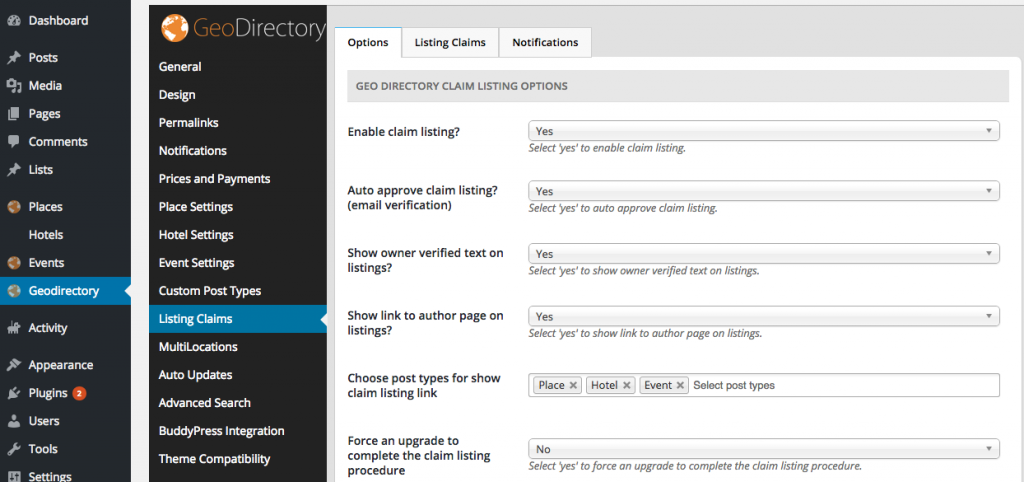
    1. Navigate to Geodirectory > Listing Claims
    2. Set Enable claim listing? to Yes
    3. Set Auto approve claim listing? (email verification) to Yes
    4. Set Show owner verified text on listings? to Yes
    5. Set Show link to author page on listings? to Yes
    6. Make sure you selected post types in Choose post types for show claim listing link
    7. Set Yes or No for Force an upgrade to complete the claim listing procedure
    8. Save Changes

Usage:

  1. Go to any listing detail page you created.
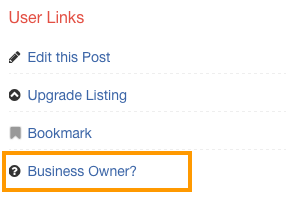
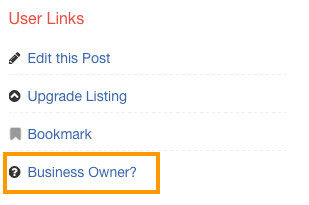
  2. Click Business Owner? link from the sidebar.
  3. Fill the Claim Form and then submit it.
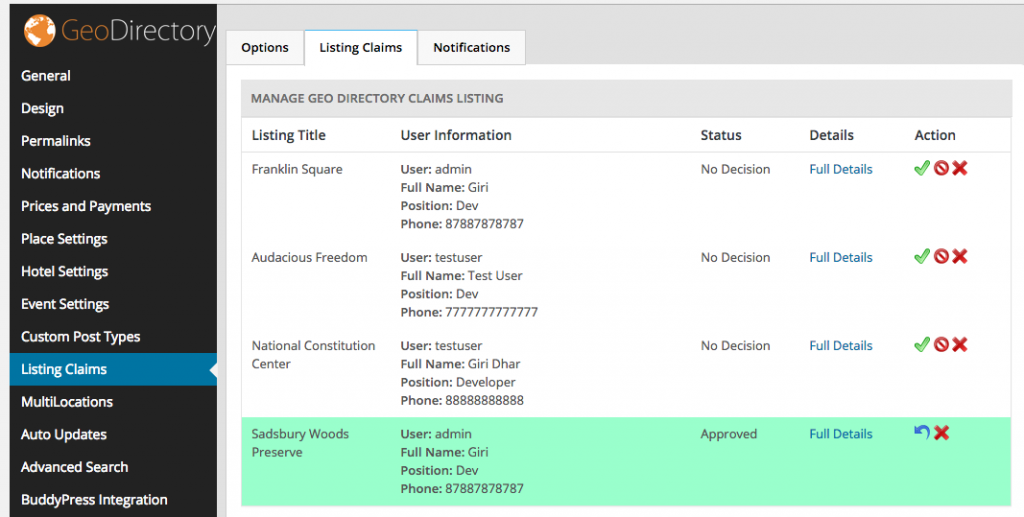
  4. All listing claims will be available under Geodirectory > Listing Claims > Listing Claims Tab
  5. You can Approve, Reject or Delete Listing Claim requests from there.

GeoDirectory Events:

If you are planning to list events on your website, then this plugin will be a big help to you. This plugin supports one time event, recurring events etc.  You can also link listings to an event.

Installation:

  1. Visit wpgeodirectory.com ( Buy a subscription if Required )
  2. Navigate to My Account > Downloads ( Login if Required )
  3. Download Geodir Event Manager zip file.
  4. Go to your WordPress site dashboard, Navigate to  Plugins > Add New > Upload Plugin
  5. Browse and Upload the zip file you downloaded from wpgeodirectory.com
  6. Activate the plugin

Links

Configuration:

  1. Navigate to Geodirectory > Design > Navigation and add Event to all the instances where Place already selected.
  2. Additional configuration available in Geodirectory > Event Settings
  3. If you don’t want recurring feature, disable it from there.
  4. To link a business follow these steps.
    1. Let’s say you would like to link Places in Events.
    2. Navigate to Geodirectory > Prices and Payments > Prices
    3. You have edit both Place package and Event package and then Set Link business to Yes
    4. Now if you visit Add Place page, you can see a new section called BUSINESSES where you can link your Places

Usage:

Visit Add Event page. You can see a section called EVENT SCHEDULE

GeoDirectory AffiliateWP Integration:

AffiliateWP is a affiliate marketing plugin. This addon helps you to integrate AffiliateWP with GeoDirectory

Installation:

  1. Visit wpgeodirectory.com ( Buy a subscription if Required )
  2. Navigate to My Account > Downloads ( Login if Required )
  3. Download Geodir AffiliateWP Integration zip file.
  4. Go to your WordPress site dashboard, Navigate to  Plugins > Add New > Upload Plugin
  5. Browse and Upload the zip file you downloaded from wpgeodirectory.com
  6. Activate the plugin

Links

Configuration:

  1. Make sure AffiliateWP wordpress plugin is active.
  2. When GeoDirectory AffiliateWP Integration plugin is active a new checkbox (GeoDirectory) will be available in Affiliates > Settings > Integrations  
  3. Check it
  4. Save Changes

GeoDirectory Ajax Duplicate Alert:

If you need unique listings, then you can use this plugin to prevent duplicate listing. It will display alert when already existing duplicate title entered for title field. You can also prevent duplicates for the following fields. Listing Title, Address, Zip/Post Code, Time, Phone, Email  

Installation:

  1. Visit wpgeodirectory.com ( Buy a subscription if Required )
  2. Navigate to My Account > Downloads ( Login if Required )
  3. Download Geodir Ajax Duplicate Alert zip file.
  4. Go to your WordPress site dashboard, Navigate to  Plugins > Add New > Upload Plugin
  5. Browse and Upload the zip file you downloaded from wpgeodirectory.com
  6. Activate the plugin

Links

Configuration:

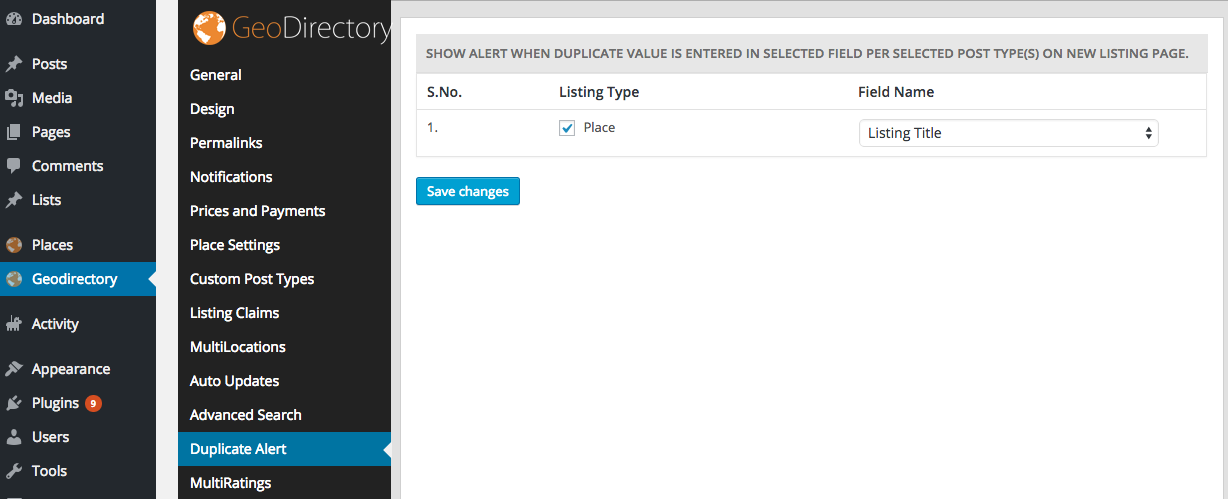
  1. Navigate to Geodirectory > Duplicate Alert
  2. Select Listing Type and Field name
  3. For example, if you want to prevent duplicate Title in Places post type, select Place for Listing Type and Listing Title for Field name  

Usage:

  1. Add Listing page will display errors like A Place with this field is already listed! Please make sure you are not adding a duplicate entry when duplicate title entered


GeoDirectory BuddyPress Integration:

This add-on helps you to integrate BuddyPress with GeoDirectory. So your users can found all their listing, edit it, delete it from BuddyPress profile page. Its a must use plugin, if you need BuddyPress support for your GeoDirectory website.

Installation:

  1. Visit wpgeodirectory.com ( Buy a subscription if Required )
  2. Navigate to My Account > Downloads ( Login if Required )
  3. Download Geodir Buddypress Integration zip file.
  4. Go to your WordPress site dashboard, Navigate to  Plugins > Add New > Upload Plugin
  5. Browse and Upload the zip file you downloaded from wpgeodirectory.com
  6. Activate the plugin

Links

Configuration:

  1. Make sure BuddyPress plugin is active
  2. Navigate to Geodirectory > BuddyPress Integration
  3. Select the post types in Show listings in BuddyPress dashboard
  4. Select the post types in Show reviews in BuddyPress dashboard
  5. Check Use BuddyPress registration form
  6. Check Redirect GD dashboard my listing link to BuddyPress profile
  7. Check Redirect GD dashboard favorite link to BuddyPress profile
  8. Check Link blog author link to the BuddyPress profile link
  9. Save Changes

Usage:

  1. Three new tabs Listings, Favorites, Reviews will be available in BuddyPress dashboard.
  2. If your username is admin, you can access buddypress dashboard using this link. http://your-domain.com//members/admin/

GD Booster:

This is a cache plugin from GeoDirectory. This plugin helps you to speed up your website. If you have large traffic on your website, then its a huge payload for your service since the pages has to be generated for each and every request. This plugin helps you to reduce server payload by caching the pages. So when the same page requested next time, it will be served from the cache instead of generating again. You can prevent server crash with good caching plugins.  GD Booster is optimised for GeoDirectory listings.

Installation:

  1. Visit wpgeodirectory.com ( Buy a subscription if Required )
  2. Navigate to My Account > Downloads ( Login if Required )
  3. Download Geodir Gd Booster zip file.
  4. Go to your WordPress site dashboard, Navigate to  Plugins > Add New > Upload Plugin
  5. Browse and Upload the zip file you downloaded from wpgeodirectory.com
  6. Activate the plugin

Links

Configuration:

  1. Navigate to GD Booster
  2. Select  Yes, enable GD Booster!
  3. Save All Changes

Usage:

  1. When GD Booster active, pages will be cached. So make sure you clear your cache if your changes not getting reflected on your website.

GeoDirectory Re-Captcha:

reCAPTCHA is a free CAPTCHA service from Google that helps protect your site against spam, malicious registrations and other forms of attacks. This addon helps you integrate reCAPTCHA to all GeoDirectory related forms.

Installation:

  1. Visit wpgeodirectory.com ( Buy a subscription if Required )
  2. Navigate to My Account > Downloads ( Login if Required )
  3. Download Geodir reCAPTCHA zip file.
  4. Go to your WordPress site dashboard, Navigate to  Plugins > Add New > Upload Plugin
  5. Browse and Upload the zip file you downloaded from wpgeodirectory.com
  6. Activate the plugin

Links

Configuration:

  1. Navigate to Geodirectory > Re-Captcha Settings
  2. Configure Google Re-Captcha Keys
  3. Check Enable Google reCAPTCHA for checkboxes for the forms you need.
  4. Save Changes

Usage:

Re-Captcha field will be available in the forms you selected.

GeoDirectory Social Importer:

With this add-on, you can import listing from facebook and yelp. Just enter the listing page url and then click “Import”. Data will be imported.

Installation:

  1. Visit wpgeodirectory.com ( Buy a subscription if Required )
  2. Navigate to My Account > Downloads ( Login if Required )
  3. Download Geodir Social Importer zip file.
  4. Go to your WordPress site dashboard, Navigate to  Plugins > Add New > Upload Plugin
  5. Browse and Upload the zip file you downloaded from wpgeodirectory.com
  6. Activate the plugin

Links

Configuration:

  1. Navigate to Geodirectory > Social Importer
  2. Configure Facebook App Details if you are planning to support facebook
  3. Configure Yelp if you are planning to support Yelp

Usage:

  1. When social importer plugin active, Import Details from Social section will be available in Add listing page.

Stripe Payment GeoDirectory Add-On:

This add-on adds, stripe payment gateway support to GeoDirectory payment manager.

Installation:

  1. Visit wpgeodirectory.com ( Buy a subscription if Required )
  2. Navigate to My Account > Downloads ( Login if Required )
  3. Download GeoDir Stripe Payment Gateway zip file.
  4. Go to your WordPress site dashboard, Navigate to  Plugins > Add New > Upload Plugin
  5. Browse and Upload the zip file you downloaded from wpgeodirectory.com
  6. Activate the plugin

Links

Configuration:

  1. Navigate to Geodirectory > Prices and Payments > Payments Tab
  2. Configure stripe gateway

Usage:

  1. Stripe gateway will be available in list of payment methods while listing upgrade. Users can proceed with stripe if they want
 

Claim Listings Add-on Overview

Introduction

In a nutshell, with this addon a user can claim the listing posted on your website.

For Example:

  1. A random user submits the business KFC, under restaurants category.
  2. Now an authorised person from KFC can claim this listing by clicking “Business owner?” link.
  3. He/She has to fill the information like Name, Contact Number, Position in Business and a message like “Hi i am the owner of this business and i would like to claim it…”.

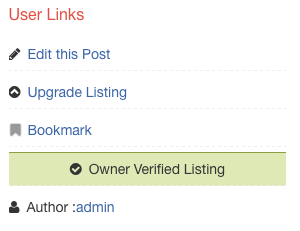
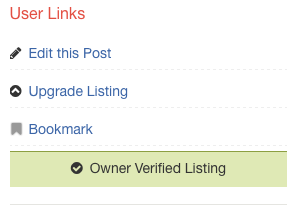
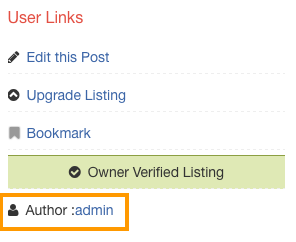
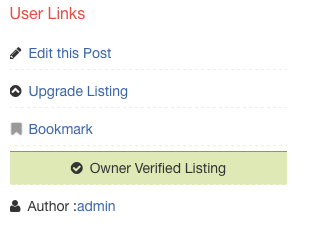
Once you approve the claim, the listing will be marked as Verified and a message will be displayed in listing page like Owner Verified Listing

Installation

  1. Visit wpgeodirectory.com ( Buy a subscription if Required )
  2. Navigate to My Account > Downloads ( Login if Required )
  3. Download Geodir Claim Listing zip file.
  4. Go to your WordPress site dashboard, Navigate to  Plugins > Add New > Upload Plugin
  5. Browse and Upload the zip file you downloaded from wpgeodirectory.com
  6. Activate the plugin.

Dependencies

Some features of this plugin may depend on the following plugin(s).

  1. Prices and Payments ( Optional )

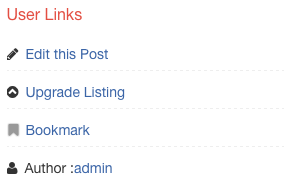
Before Business Claim

beforeclaim

After Business Claim

afterclaim

Configuration

After plugin activation, you will be redirected to Listing Claims page.

claim-listings

Options Tab

GeoDirectory Claim Listing Options

  1. Enable claim listing?
    1. Select ‘yes’ to enable claim listing.
    2. When set to No, claim listing will be disabled. However you can still view old listing claims by clicking Listing Claims tab.
  2. Auto approve claim listing? (email verification)
    1. Select ‘yes’ to auto approve claim listing.
    2. When set to Yes, a verification email will be sent to logged in user’s email address when the user submit Business Owner? form
    3. Verification Email content would look like this.
      1. Dear Client,Your request to become the owner of the below listing needs to be verified. By clicking the VERIFY link below you are stating you are legally associated with this business and have the owners consent to edit the listing. If you are not associated with this business and edit the listing with malicious intent you will be solely liable for any legal action or claims for damages. Thank you 
    4. You can modify the email content by visiting this page.  GeoDirectory > Listing Claims > Notifications Tab > Claim listing verification required
  3. Show owner verified text on listings?
    1. Select ‘yes’ to show owner verified text on listings.
    2. When set to No
      1. showverifiedtextno
    3. When set to Yes
      1. showverfiedtextyes
  4. Show link to author page on listings?
    1. Select ‘yes’ to show link to author page on listings.
    2. When set to No
      1. showauthorno
    3. When set to Yes
      1. showauthoryes
  5. Choose post types for show claim listing link
    1. Select post types
    2. For the selected post types Business Owner? link will be displayed on the listing detail page.
    3. businessownerlink
  6. Force an upgrade to complete the claim listing procedure
    1. Select ‘yes’ to force an upgrade to complete the claim listing procedure.
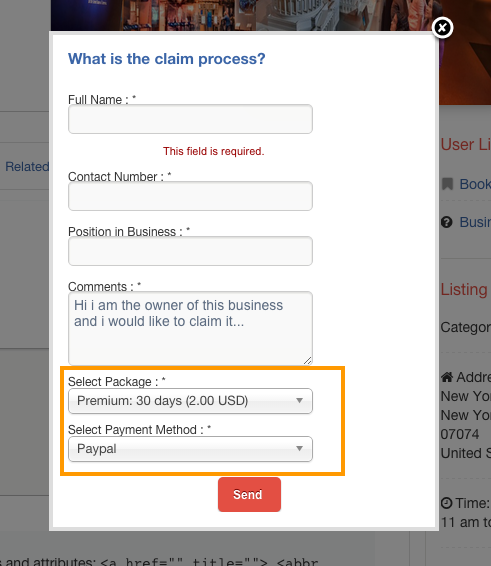
    2. Note: This option requires Prices and Payments addon. So make sure its active if you are planning to use this option. Otherwise this option will be useless.
    3. Note: Make sure you configured Prices and Payments addon properly.
    4. With prices and payments addon, the business claim popup looks like this.
    5. pricesandpaypopup

Listing Claims Tab

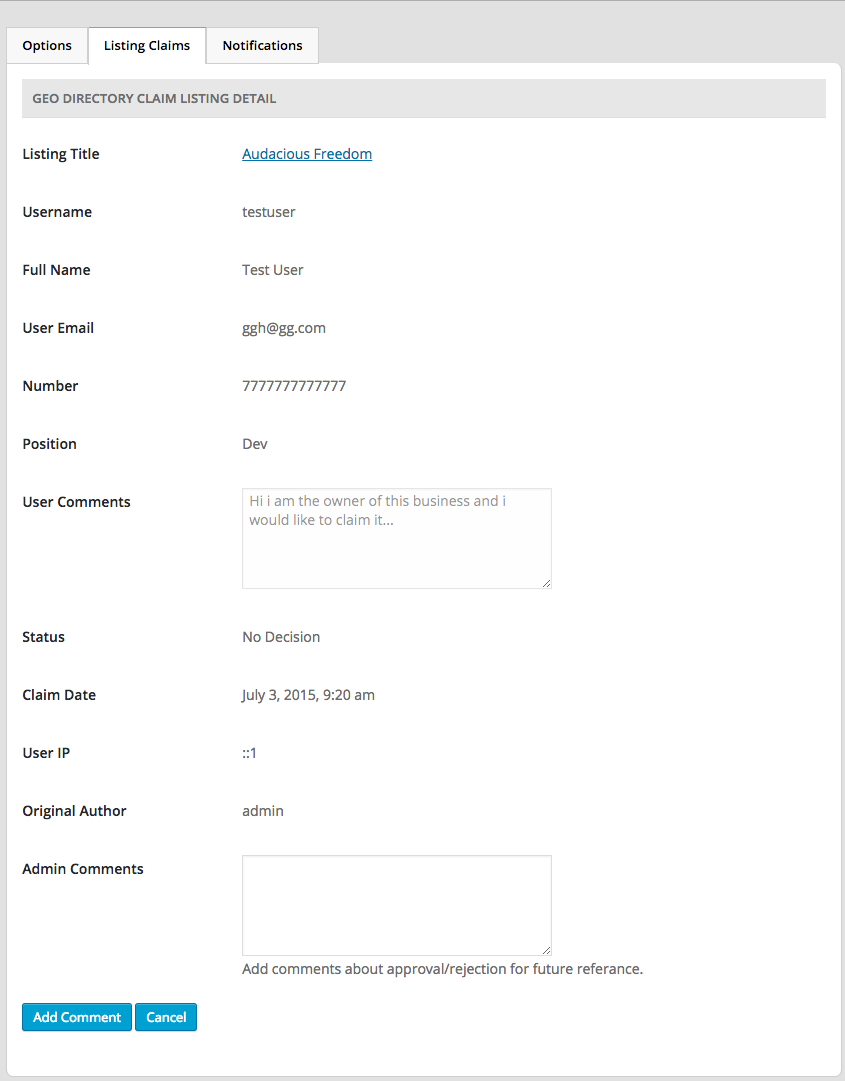
listingclaimstab

Full Details page

  1. Listing Title
    1. The Listing title for which the claim was made.
  2. Username
    1. Username of the Claimer.
  3. Full Name
    1. Full name of the Claimer
  4. User Email
    1. Email of the Claimer.
  5. Number
    1. Phone number of the Claimer.
  6. Position
    1. The Claimer’s position in his/her company.  Ex: CEO, Marketing Manager etc.
  7. User Comments
    1. The Claimer’s message to the admin.
  8. Status
    1. The status of the claim. Possible values are
      1. No Decision
      2. Approved
      3. Rejected
  9. Claim Date
    1. The date when the claim was made.
  10. User IP
    1. The Claimer’s IP address.
  11. Original Author
    1. The username of the person who created the listing.
  12. Admin Comments
    1. Add comments about approval/rejection for future reference.

Notifications Tab

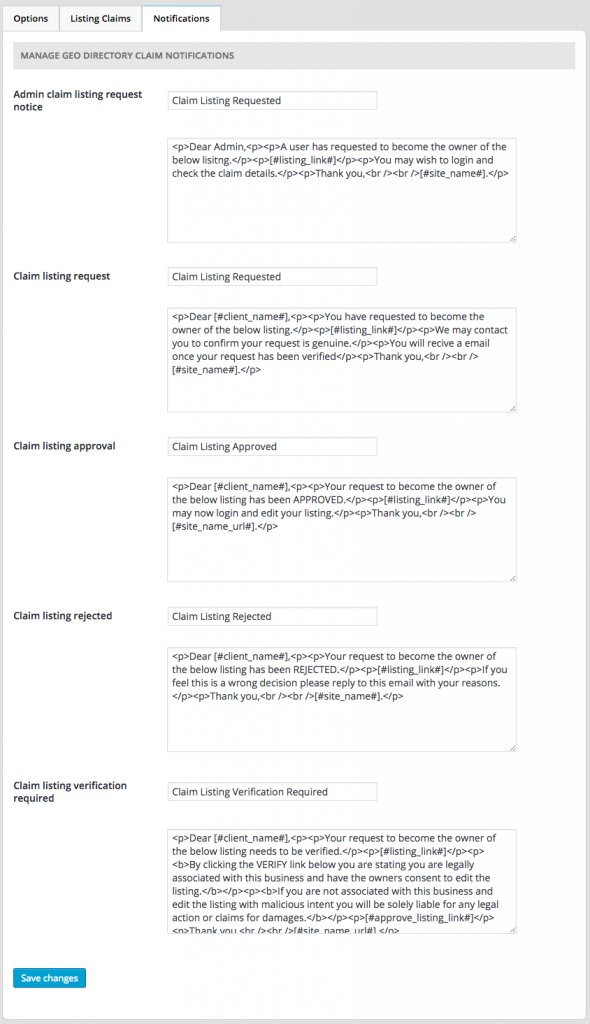
This is where you set Email Subject and Email Content of Claim Listing related emails.

notificationstab

  1. Admin claim listing request notice
    1. This email will be sent to site Admin
    2. This email will be triggered, when a claim is requested.
    3. Default subject would be: Claim Listing Requested
    4. The email content would look like

      Dear Admin,

      A user has requested to become the owner of the below lisitng.

      [#listing_link#]

      You may wish to login and check the claim details.

      Thank you,

      [#site_name#].


  2. Claim listing request
    1. This email will be sent to the Claimer.
    2. This email will be triggered, when a claim is requested.
    3. Default subject would be: Claim Listing Requested
    4. The email content would look like

      Dear [#client_name#],

      You have requested to become the owner of the below listing.

      [#listing_link#]

      We may contact you to confirm your request is genuine.

      You will recive a email once your request has been verified

      Thank you,

      [#site_name#].


  3. Claim listing approval
    1. This email will be sent to the Claimer.
    2. This email will be triggered, when a claim is approved by site admin.
    3. Default subject would be: Claim Listing Approved
    4. The email content would look like

      Dear [#client_name#],

      Your request to become the owner of the below listing has been APPROVED.

      [#listing_link#]

      You may now login and edit your listing.

      Thank you,

      [#site_name_url#].


  4. Claim Listing Rejected
    1. This email will be sent to the Claimer.
    2. This email will be triggered, when a claim is rejected by site admin.
    3. Default subject would be: Claim Listing Rejected
    4. The email content would look like

      Dear [#client_name#],

      Your request to become the owner of the below listing has been REJECTED.

      [#listing_link#]

      If you feel this is a wrong decision please reply to this email with your reasons.

      Thank you,

      [#site_name#].


  5. Claim Listing Verification Required
    1. This email will be sent to the Claimer.
    2. This email will be triggered, when a claim is requested and Auto approve claim listing? option set to Yes.
    3. Default subject would be: Claim Listing Verification Required
    4. The email content would look like

      Dear [#client_name#],

      Your request to become the owner of the below listing needs to be verified.

      [#listing_link#]

      By clicking the VERIFY link below you are stating you are legally associated with this business and have the owners consent to edit the listing.

      If you are not associated with this business and edit the listing with malicious intent you will be solely liable for any legal action or claims for damages.

      [#approve_listing_link#]

      Thank you,

      [#site_name_url#].


Testing Claim Manager for “Auto approval”

Testing claim functionality is done in multiple steps. This test uses the following settings:

  • Geodirectory – Listing Claims – Enable claim listing? – Check
  • Geodirectory – Listing Claims – Auto approve claim listing? (email verification) – Check
  • Create user called “Owner” with a secondary email that is accessible (Owner email)

Admin:

  • Navigate to the site and Login as Admin
  • Create new listing “Owner Listing” – Set Owner Email as Listing Email
  • Publish listing

Owner:

  • Navigate to the site and Login as Owner (use a different browser, or open a new window in Chrome incognito with ctrl-shift-N)
  • Navigate to the listing
  • Click claim link to claim listing (‘Business Owner’ or ‘Claim’ if you are using Supreme)
  • Complete the the form
  • Submit form
  • Check Owner Email for “Claim listing verification required” Notification
  • Follow Link in Email to verify claim of the listing (link will only work if the Owner opens it and is able to login to the site.).
  • Check Owner Email for “Claim listing approval” Notification

If you have done this process and do not have success, you can make a new support request as follows.

Make a new topic in the right forum: https://wpgeodirectory.com/support/forum/claim-listings-addon/claim-listings-addon-support/

Include the following information:

WP Login URL:
Listing URL (to be claimed by Owner):
WP Username for Owner:
WP Password for Owner:
WP Username for Admin:
WP Password for Admin:

Marker Cluster Add-on Overview

Introduction

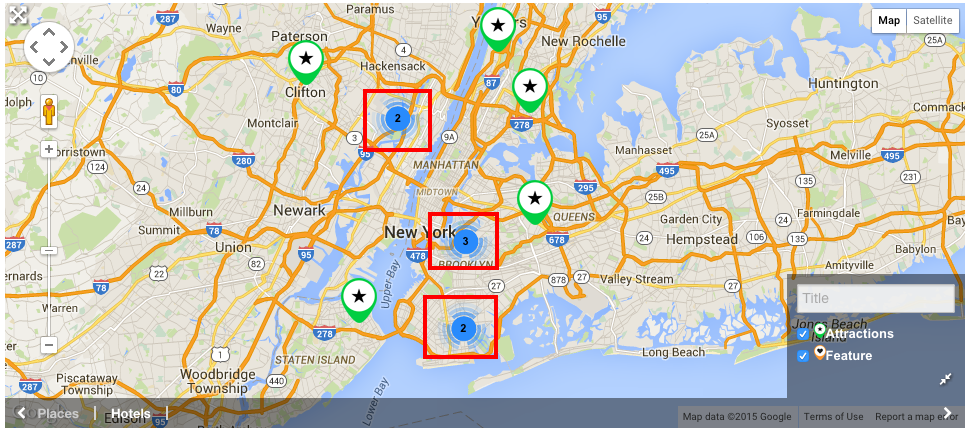
The marker cluster addon improves map and site performance by clustering markers from nearby locations. The single ‘marker cluster’ represents several locations at once, and clicking the cluster zooms in and expands the individual markers.

If you have multiple widget maps you can use the settings to choose which widget maps display clusters.

Installation

  1. Visit wpgeodirectory.com ( Buy a subscription if Required )
  2. Navigate to My Account > Downloads ( Login if Required )
  3. Download Geodir Marker Cluster zip file.
  4. Go to your WordPress site dashboard, Navigate to  Plugins > Add New > Upload Plugin
  5. Browse and Upload the zip file you downloaded from wpgeodirectory.com
  6. Activate the plugin.

Configuration

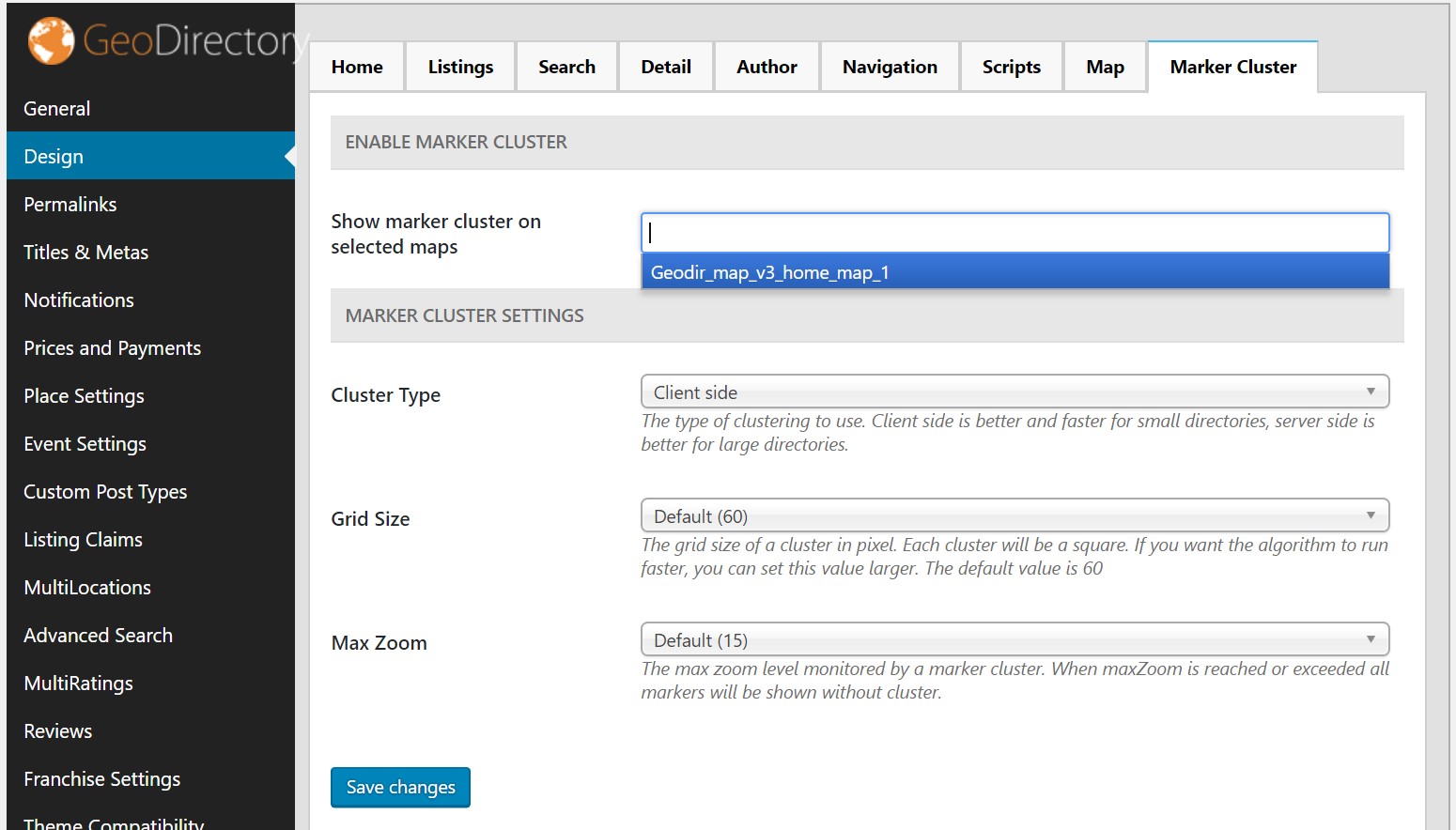
Navigate to Geodirectory > Design > Marker Cluster

Enable Marker Cluster

  1. Show marker cluster on selected widget maps
    1. select the widget map names to apply marker cluster.
    2. if you see no items in dropdown that means you are not using any widget maps in WordPress – Appearance – Widgets.
      1. Navigate to Appearance > Widgets and then use GD > GMap Home Page widget in GD Home Top section
    3. Clusters are marked with red square in the following screenshot.

Marker Cluster Settings

  1. Cluster Type
    1. Server side rendering can be used to improve performance of GD Home Maps created with widgets and shortcodes.
  2. Grid Size
    1. The grid size of a cluster in pixel.
    2. Each cluster will be a square.
    3. If you want the algorithm to run faster, you can set this value larger.
    4. The default value is 60
  3. Max Zoom
    1. The max zoom level monitored by a marker cluster.
    2. When maxZoom is reached or exceeded all markers will be shown without cluster.
    3. The default value is 15

Ajax Duplicate alert Add-on Overview

Introduction

Keep your database clean and free from duplicate or degraded entries with the Ajax Duplicate Alert add-on.

With the add-on activated, GeoDirectory will check new entry titles in real time against those already among the titles in the database. If it finds a match, it will warn the user that they are about to add a duplicate. The user will be prompted to check the existing entry before going ahead with their new entry.

It is easy to set parameters for the add-on to check. For each custom post type (CPT) you can specify whether the add-on should check against: Listing Title; Address; Phone or E-mail.

Installation

  1. Visit wpgeodirectory.com ( Buy a subscription if Required )
  2. Navigate to My Account > Downloads ( Login if Required )
  3. Download Geodir Ajax Duplicate Alert zip file.
  4. Go to your WordPress site dashboard, Navigate to  Plugins > Add New > Upload Plugin
  5. Browse and Upload the zip file you downloaded from wpgeodirectory.com
  6. Activate the plugin.

Configuration

You will be automatically redirected to Duplicate Alert setting page, after plugin activation.

To Enable Ajax Duplicate Alert for a Post Type

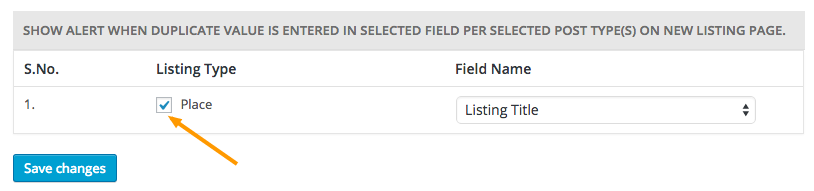
To Enable Ajax Duplicate Alert for a Post Type,  please make sure you checked the checkbox right next to the Post Type name.

checked

Available Field Names

  1. Listing Title
    1. When selected
      1. listtitle
  2. Address
    1. When selected
      1. address
  3. Zip/Post Code
    1. When selected
      1. zip
  4. Time
    1. When selected
  5. Phone
    1. When selected
      1. phone
  6. Email
    1. When selected
      1. email

Franchise addon filters

You can use these filters in your child theme’s functions.php file.

Change the tab

  • This code will change the title of the More Franchises tab: change More Branches to the text of your choice.
  • You can change gd_place to use the code for another custom post type.

[php]
function geodir_franchise_change_franchises_tab_text($text, $post_type) {
if ($post_type == ‘gd_place’) {
$text = __(‘More Branches’, ‘geodir-franchise’);
}
return $text;
}
add_filter( ‘geodir_franchise_franchises_tab_text’, ‘geodir_franchise_change_franchises_tab_text’, 10, 2 );
[/php]

Change the link to all franchise listings

  • This code will change the title of the View all franchises link: change View all branches to the text of your choice.
  • You can change gd_place to use the code for another custom post type.

[php]
function geodir_franchise_change_all_link_text($text, $post_type) {
if ($post_type == ‘gd_place’) {
$text = __(‘View all branches’, ‘geodir-franchise’);
}
return $text;
}
add_filter( ‘geodir_franchise_all_franchises_link_text’, ‘geodir_franchise_change_all_link_text’, 10, 2 );
[/php]

Change the Add franchise link

  • This code will change the title of the Add Franchise link: change Add Branch to the text of your choice.
  • You can change gd_place to use the code for another custom post type.

[php]
function geodir_franchise_change_add_link_text($text, $post_type) {
if ($post_type == ‘gd_place’) {
$text = __(‘Add Branch’, ‘geodir-franchise’);
}
return $text;
}
add_filter( ‘geodir_franchise_add_franchise_link_text’, ‘geodir_franchise_change_add_link_text’, 10, 2 );
[/php]

Getting Addon Translation Files

This document applies to Addons. GD Core plugin translations are located on WP.org. See the Translators Handbook for more information.

GeoDirectory Addon translations are maintained in the GeoDirectory language project.

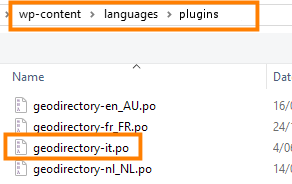
In the example below, an Italian translation will added to a multi-lingual GD site. The process for a single language site is the same.

  1. Navigate to the GeoDirectory language project pages.
  2. Select the language and addon of your choice.
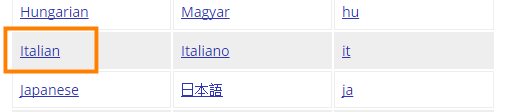
  3. Example: Italian:
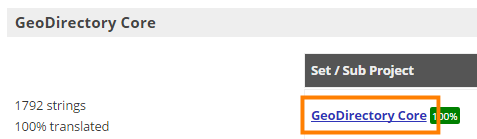
  4. Select the language file you want:
  5. Scroll to the bottom of the page and Export the file (accept the defaults so you download the whole PO file):
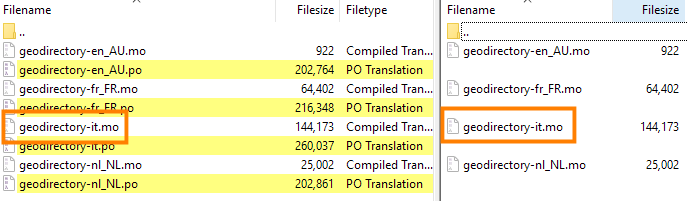
  6. Load the file to the proper folder (See Translating Addons for more information).
    Change the file extension, if necessary, for your locale. Example: -it to -it_IT.
  7. Create the MO file using PoEdit or download from the same page where you downloaded the PO file:
  8. Review the translations on your site. If you find untranslated strings, refer here for how to translate strings with PoEdit.

Server requirements

On this page:

Introduction Managed WordPress Hosting Suggested Hosts

Introduction

WordPress in general requires more than shared hosting for anything bigger than a tiny blog or a static website.

GeoDirectory will not perform very well on shared hosting servers, even if only a few other plugins are installed.

The optimal server solution will depend on several factors, such as:

  1. Theme used (there are some themes that are so resource heavy that even without extra plugins they will choke on shared servers)
  2. Number of plugins
  3. Number of listings
  4. Amount of visitors

We normally suggest to start at least with a decent VPS (virtual private server), with 2GB of RAM.

The best performances for a GD site are to be expected on dedicated servers with 8GB of RAM or more.

Managed WordPress Hosting

All managed WordPress hosting uses caching systems that are not compatible with GD’s geolocation features.
Managed WordPress hosting is good only for blogs or static websites.

The only caching system that works with GD is GD Booster or WP Super Cache, and all other caching needs to be disabled. (this will no longer be valid starting from V2 of GeoDirectory that will be compatible with all caching systems)

Suggested Hosts

We have our demos installed on Spectrum Technologies Group LLC. Spectrum Technologies Group LLC is managed by one of our most faithful customers and we are satisfied with performances and we do highly recommend them.

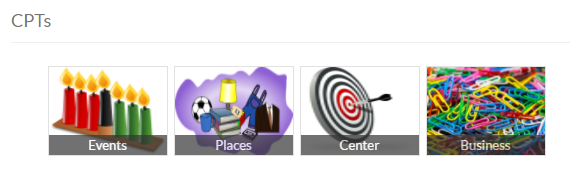
Custom Post Type Shortcodes

CPT Listings

Shortcode: [gd_cpt_listings]

Parameters:

  • cpt_img_width – width of the thumbnail for the CPT
  • cpt_img_height – height of the thumbnail for the CPT
  • title – the title for the cpt listings
  • cpt_exclude – post types to exclude (default shows all) (examples: ‘gd_place’ or ‘gd_place,gd_event’)
  • cpt_hide_name – hide CPT name? True or False (default = false)

This example shows a widget with the CPT images at 120×90 pixels:
[gd_cpt_listings cpt_img_width=120 cpt_img_height=90]

This example shows a widget with a custom title, and does not show a link to the gd_place CPT:
[gd_cpt_listings title="Browse listings" cpt_exclude=gd_place]

Franchise Manager Add-on

On this page

Introduction Applications Installation Configuration Integration with the Pricing Manager addon
Usage Adding the main listing Adding the branch listingsPrice Options

Introduction

The Franchise Manager allows users to submit listings for chains of businesses or franchises faster and allows directory owners to monetize those listings in a smarter way if combined with the Prices and Payments Addon.

After entering the main listing for a new Chain, fields of the Add Listing form can be locked. This way you can pre-populate most fields but allow the address, telephone number and email address to be entered separately for all branches of the chain. When the main listing is edited, locked fields are edited for all branches too.

If the Prices and Payments Addon is installed, you need to enable franchises for the price packages of your choice, and you can set a different price for the main listing and a different price for the extra branches.
If not using the Prices and Payments addon, franchises will automatically be activated for all of your listings.

A new tab appears in all listings belonging to a franchise, showing the other franchisees listings.

It is possible to browse the list of all franchisees belonging to the same chain in a regular listings page too.

Applications

Here are a few examples to give you an idea how you could use the Franchise Manager:

Main listing Branch listings
Fast food chain All locations
Brewer of special beer All distributors
Rock band All regular venues where the band plays
Dietician All health centers visited regularly

Installation

Installation is done by uploading the ZIP file in the plugin section of your WordPress admin area.

Installing GD Addons

Configuration

Setup

Once you activated the Franchise Manager, you will get a new set of settings in the GD admin panel:

Most settings at GD > Franchise Settings are straight forward.

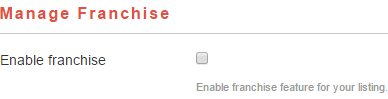
First you need to select the Custom Post Type(s) where you want to enable the Franchise features:

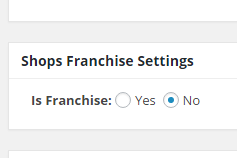
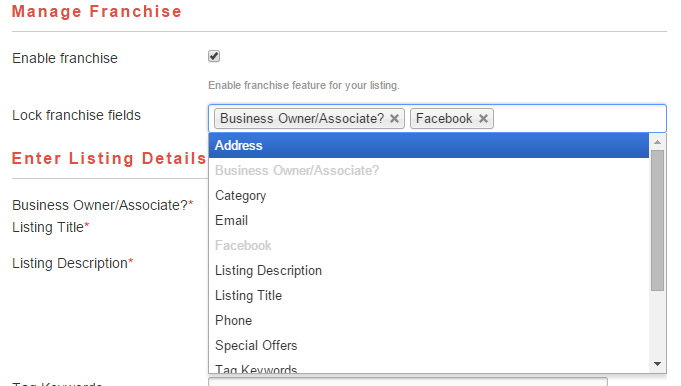
If you are not using the Payments Manager, then a new option will be available in both the frontend and backend Add Listing form for that CPT:

Frontend Backend

Integration with the Pricing Manager addon

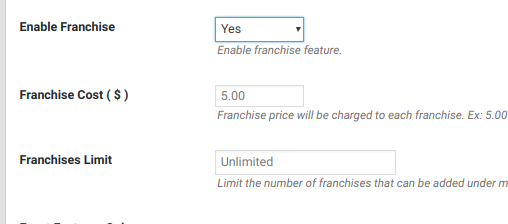
  1. If you are using the Payments Manager addon, then you will need to allow Franchises in the relevant price package before your users will have the option to use the franchise feature.
  2. You will first need to Enable Franchise in the price package and then save.
  3. Then re-edit the same price package to set the Franchise Cost and  the Franchises Limit.

Usage

Adding the main listing

  1. When the user add their main listing, they can lock selected fields for all the branch listings.
  2. The locked fields will be auto-populated in any branch listing submitted.
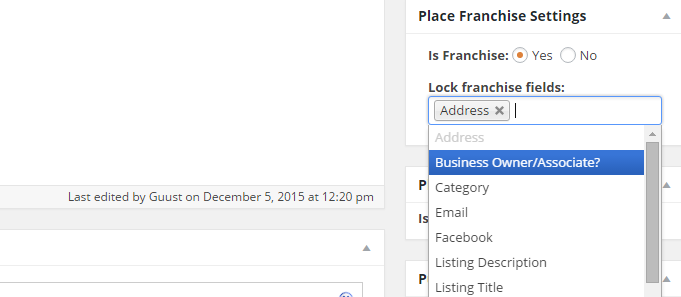
  3. If adding a franchise in the backend, these options will appear in the sidebar:

Adding the branch listings

  1. Branch listings can only be submitted by the same user that added the main listing.
  2. Branch listings need to be added from the front end.
  3. The custom fields locked by the main listing owner cannot be edited in the branch listings.
  4. If the main listing owner updates a locked field in the main listing, the same custom field will be updated in all branch listings.
    Example: a fast food chain has locked the special offer field, and can change that field on all branch listings to run a promotion in all the stores.

Price Options

If you are all setup and ready to sell the franchise listing option to your listing owner customers, then you will need to add the franchise option to at least once of your Price Packages. Go to:

GeoDirectory – Prices and Payments – Prices (tab) – Edit (choose a package to allow franchises)

Adjust the franchise options for the package as desired.

Common code snippets

On this page:

Introduction Add the package ID to the body attribute Adding CPT-specific content on top of the Add Listing page Making the listing description optional Sorting on Listings pages: Featured first, then alphabetic Detail Page Hide ‘No Reviews’ Remove GD Scripts Supreme Directory Showing icons instead of category links in list and grid view

Introduction

We recommend using the Code Snippets plugin to add custom PHP code.
CSS can be added to GD > Design > Scripts

Add the package ID to the body attribute

  1. If you want to change the looks of the detail page depending on the price package, you can do that by adding the ID to the code of the detail page:
  2. To do this, add this code to your child theme’s functions.php file:

    [php]
    // add the package id to the body
    add_filter( ‘body_class’, ‘my_add_package_class’,10,1 );
    function my_add_package_class($class){
    global $post;
    if (geodir_is_page(‘detail’) && isset($post->package_id)) {
    $class[] = "gd-package-id-".$post->package_id;
    }
    return $class;
    }
    [/php]

  3. You can now target elements of the detail page using the package ID class, for example

    [css]
    .gd-package-id-1 .geodir-tags {display: none}
    [/css]

    would hide tags for price packages with ID 1.

Adding CPT-specific content on top of the Add Listing page

  1. If you want to add any special content to your Add Listing page, you can just add that in the content section using the normal way of editing your WP page “Add Listing”.
  2. If you want to add content specific to a CPT you can use this code, adjust as required:

    [php]
    function geodir_add_place_before_main_content_custom() {
    if (isset($_GET[‘listing_type’]) && $_GET[‘listing_type’] == ‘gd_place’) {
    ?>

    <div>bla bla</div>

    <?php
    }
    }
    add_action(‘geodir_add_listing_before_main_content’, ‘geodir_add_place_before_main_content_custom’);
    [/php]

Making the listing description optional

  1. The listing description field on the Add Listing page is a required field by default.
  2. You can make the description field optional by adding some JS and CSS code.
  3. Add the following code to GD > Design > Scripts tab > Footer script code:

    [javascript]
    <img src="data:image/gif;base64,R0lGODlhAQABAIAAAAAAAP///yH5BAEAAAAALAAAAAABAAEAAAIBRAA7" data-wp-preserve="%3Cscript%20type%3D%22text%2Fjavascript%22%3E%0AjQuery(%20document%20).ready(function()%20%7B%0A%20%20%20%20jQuery(%22%23geodir_post_desc_row%22).removeClass(%22required_field%22)%3B%0A%7D)%3B%0A%3C%2Fscript%3E" data-mce-resize="false" data-mce-placeholder="1" class="mce-object" width="20" height="20" alt="&lt;script&gt;" title="&lt;script&gt;" />
    [/javascript]

  4. Also add the following CSS code:

    [css]
    #geodir_post_desc_row label span,
    #geodir_post_desc_row .geodir_message_error {
    display:none !important;
    }
    [/css]

Sorting on Listings pages: Featured first, then alphabetic

  1. The sorting options for listings can only set one default sorting option.
  2. The following code will order alphabetically even if the default order is set to show featured listings first:

    [php]
    add_filter(‘geodir_posts_order_by_sort’,’_my_custom_order_by’,10,3);
    function _my_custom_order_by($orderby, $sort_by, $table){
    global $wpdb;

    if($sort_by==’is_featured_asc’){
    $orderby .= " $wpdb->posts.post_title ASC, ";
    }
    return $orderby;
    }
    [/php]

Detail page – hide ‘No Reviews’ text if there are no reviews

  1. Maybe you have a new site without a lot of reviews.
  2. The following code will hide the ‘no Reviews’ text

    [php]
    function _gd_custom_hide_no_review_text( $class ) {
    global $post;
    if ( empty( $post->rating_count ) ) {
    $class .= ‘gd-custom-no-review’;
    }
    return $class;
    }
    add_filter( ‘geodir_post_view_article_extra_class’, ‘_gd_custom_hide_no_review_text’, 10, 1 );
    [/php]

    And this short bit of CSS
    .gd-custom-no-review .geodir-entry-meta a.geodir-pcomments {
    display: none !important;
    }

Snippet to Remove GeoDirectory Scripts

Some site owner may want to optimize their site by loading GD scripts only on GD pages. The following applies only to GD core. Each Addon has additional scripts.
In GD core most of the scripts and styles are loaded via geodir_templates_scripts() and geodir_templates_styles() functions. You can use the following to skip loading of GD Core scripts.

[php]
remove_action( ‘wp_enqueue_scripts’, ‘geodir_templates_scripts’ );
remove_action( ‘wp_enqueue_scripts’, ‘geodir_templates_styles’, 8 );
[/php]

geodir_is_geodir_page() is used to identify the GD page

Here’s a Snippet that will execute only on GD Pages.
*Caution* – Snippet below is only capable of detecting GD Pages, and will not detect other WP pages where you might be using a shortcode or widget. Use with Caution!

[php]
add_action( ‘wp’, ‘wpdocs_dequeue_script’, 100 );
function wpdocs_dequeue_script() {
if (!geodir_is_geodir_page()){
remove_action(‘wp_enqueue_scripts’, ‘geodir_templates_scripts’);
remove_action(‘wp_enqueue_scripts’, ‘geodir_templates_styles’, 8);
}
}
[/php]

Common Code Snippets for Supreme Directory

See the Supreme Directory FAQ page

Showing icons instead of category links in list and grid view

Let’s change this

into this

  1. Make sure to add categories to the Listings pages, as explained here:
  2. Now add this PHP code as a new Code Snippet or to your child theme’s functions.php:

    [php]
    function _gd_custom_listing_view_category_icon( $html, $location, $cf ) {
    global $post, $_gd_custom_term_icons;

    $html_var = $cf[‘htmlvar_name’];

    if ( !empty( $post->post_type ) && $html_var == $post->post_type . ‘category’ && !empty( $post->{$html_var} ) ) {
    if ( empty( $_gd_custom_term_icons ) ) {
    $_gd_custom_term_icons = geodir_get_term_icon();
    }

    $post_taxonomy = $post->post_type . ‘category’;
    $field_value = $post->{$html_var};
    $links = array();
    $terms = array();
    $termsOrdered = array();
    if (!is_array($field_value)) {
    $field_value = explode(",", trim($field_value, ","));
    }

    $field_value = array_unique($field_value);

    if (!empty($field_value)) {
    foreach ($field_value as $term) {
    $term = trim($term);

    if ($term != ”) {
    $term = get_term_by(‘id’, $term, $html_var);
    if (is_object($term)) {
    $term_icon_url = ! empty( $_gd_custom_term_icons ) && isset( $_gd_custom_term_icons[ $term->term_id ] ) ? $_gd_custom_term_icons[ $term->term_id ] : ”;
    $term_link = ‘<a title="’ . esc_attr( $term->name ) . ‘" href="’ . esc_attr(get_term_link($term, $post_taxonomy)) . ‘"><img src="’ . $term_icon_url . ‘" alt="’ . esc_attr( $term->slug ) . ‘ icon" class="_gd-custom-cat-icon" /></a>’;
    //$term_link .= " <a href=’" . esc_attr(get_term_link($term, $post_taxonomy)) . "’>" . $term->name . "</a>";
    $links[] = $term_link;
    $terms[] = $term;
    }
    }
    }
    if (!empty($links)) {
    // order alphabetically
    asort($links);
    foreach (array_keys($links) as $key) {
    $termsOrdered[$key] = $terms[$key];
    }
    $terms = $termsOrdered;
    }
    }
    //$html_value = !empty($links) && !empty($terms) ? wp_sprintf(‘%l’, $links, (object)$terms) : ”;
    $html_value = !empty($links) ? implode(‘ ‘, $links) : ”;

    if ($html_value != ”) {
    $field_icon = geodir_field_icon_proccess($cf);
    if (strpos($field_icon, ‘http’) !== false) {
    $field_icon_af = ”;
    } else if ($field_icon == ”) {
    $field_icon_af = ”;
    } else {
    $field_icon_af = $field_icon;
    $field_icon = ”;
    }

    $html = ‘
    <div class="geodir_more_info ‘ . $cf[‘css_class’] . ‘ ‘ . $html_var . ‘" style="clear:both;"><span class="geodir-i-taxonomy geodir-i-category" style="’ . $field_icon . ‘">’ . $field_icon_af;
    $html .= (trim($cf[‘site_title’])) ? __($cf[‘site_title’], ‘geodirectory’) . ‘: ‘ : ”;
    $html .= ‘</span> ‘ . $html_value . ‘</div>

    ‘;
    }
    }

    return $html;
    }
    add_filter( ‘geodir_custom_field_output_taxonomy_key_taxonomy’, ‘_gd_custom_listing_view_category_icon’, 10, 3 );
    [/php]

  3. And add this CSS:
    [css]
    .geodir_category_list_view ._gd-custom-cat-icon {
    vertical-align: middle;
    height: 24px;
    margin: 0 5px;
    }
    [/css]